Just before the holidays, Jill Eberhardt says scammers hit her PayPal account with a $1,010 unauthorized transaction. Although her bank, Chase, immediately identified the unusual “purchase” from Maple & Mist Café as fraudulent, PayPal disagreed. It determined she had authorized the transaction — and PayPal’s opinion was the only one that mattered.
Eberhardt’s money was gone.
That set Eberhardt on a frustrating battle to retrieve her cash from criminals who had convinced PayPal of their legitimacy.
After repeated unsuccessful attempts to appeal PayPal’s decision, a desperate Eberhardt reached out to Consumer Rescue. She hoped we could actually do what our name implies and rescue her from this expensive nightmare.
But what had those scammers done to persuade PayPal to side with them? Eberhardt’s case hinged on that detail and that’s what I aimed to find out.
Expecting a $60 purchase to show up in her PayPal account
A little more than a week before Christmas, Eberhardt was doing some last-minute shopping online.
“As soon as I hit purchase, there was a charge of $1,010 showing on my PayPal account,” Eberhardt told me. “It was instantaneous.”
At the same time she received a transaction notification from PayPal, Chase sent her one too. That message said her bank had flagged the unusually high debit to her savings account as fraudulent.
Eberhardt quickly signed into her PayPal account and reported the unauthorized transaction from Maple & Mist Café — a company she had never heard of before.
“I was obviously anxious to get the charge reversed and confused about how it had happened,” Eberhardt recalled.
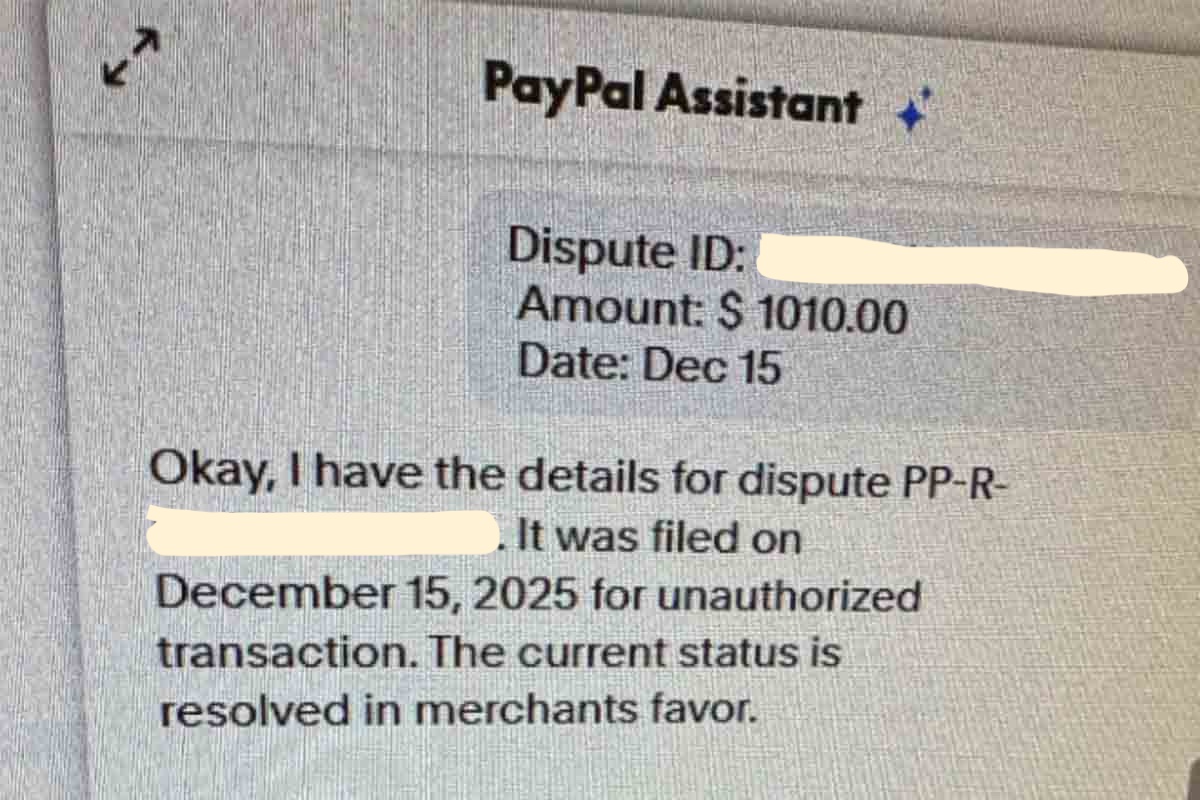
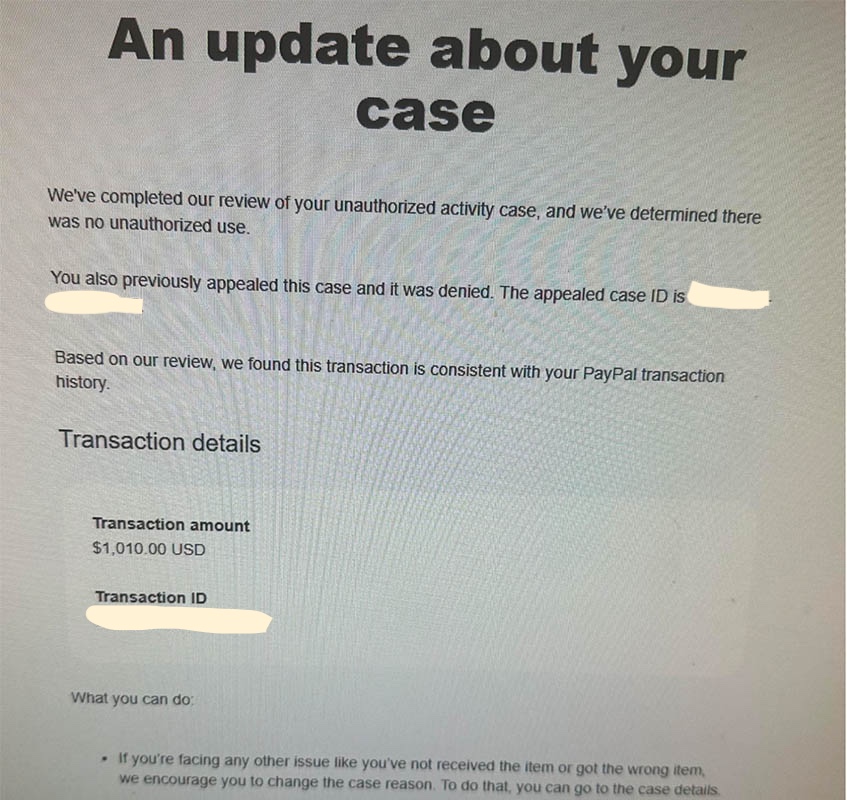
But within 15 minutes Eberhardt’s anxiety and confusion over the charge would increase by tenfold. Not only did PayPal not explain what had gone wrong, it found in favor of the merchant. Nothing was unusual about the $1,010 purchase from Maple & Mist Café according to the PayPal Assistant making the decision.
The PayPal Assistant resolved Eberhardt’s complaint in favor of the “merchant” within minutes.
Note:PayPal describes its Assistant as a generative artificial intelligence that can help customers respond to purchase issues and active cases. In Eberhardt’s case, though, the Assistant quickly ruled in the merchant’s favor — no questions asked.
A rejected appeal leaves this PayPal account $1,010 in the red
Shocked by the swift dismissal of her fraud complaint, Eberhardt filed an appeal, which was just as quickly rejected.
My appeal was also denied within minutes. I couldn’t believe it. That is a lot of money and because Chase refused the charge, my PayPal Account was in the negative. I had returned a few purchases during the holidays and PayPal took all my refunds to pay the scammers. That’s not fair.
Jill Eberhardt
Even after PayPal repossessed those legitimate refunds, Eberhardt’s account was deep in the red. That giant charge from the pleasant-sounding, but actually sinister, Maple & Mist Café, was ruining the holidays.
In desperation, Eberhardt filed yet another appeal and this time, she didn’t get an immediate rejection from the AI assistant. Instead, she received a message from PayPal that her complaint was being investigated. It noted that she had already appealed the transaction previously, but now it seemed to be moving to a different level of review.
Eberhardt was hopeful that her case would soon be scrutinized by a human from the PayPal team who would easily identify the charge as fraudulent.
Hope dashed, appeal rejected, PayPal shares “proof” of a valid transaction
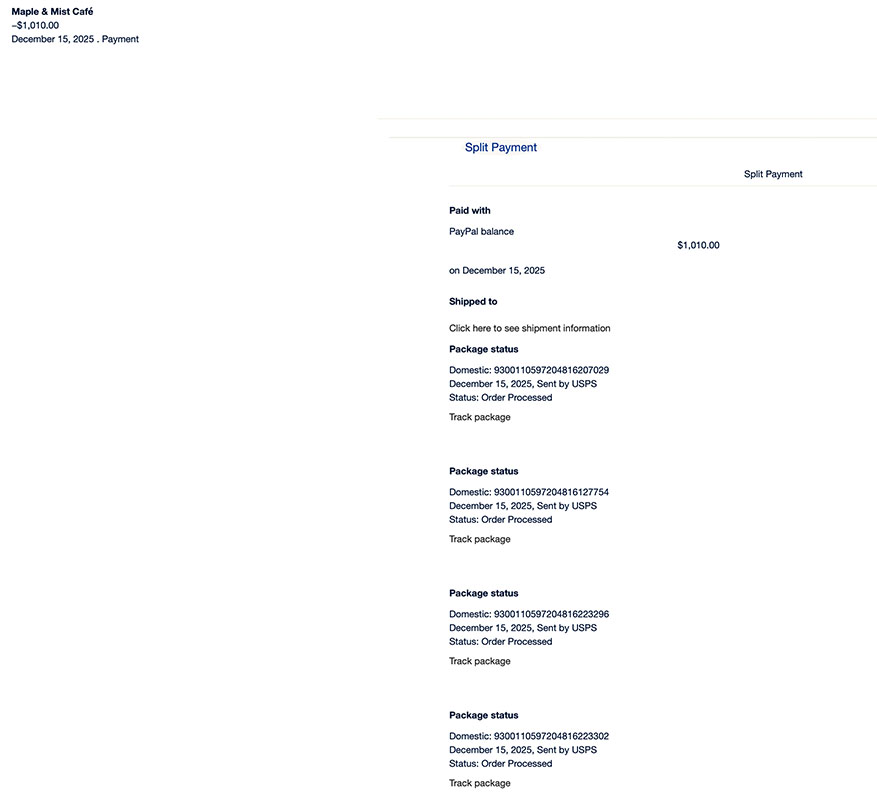
However, that isn’t what happened. Instead, just a few days later, Eberhardt received the final reconfirmation from PayPal that the charge would stand. But this time, the company provided evidence that the merchant had shared to support the $1,010 charge. That evidence included several USPS tracking numbers with proof of delivery.
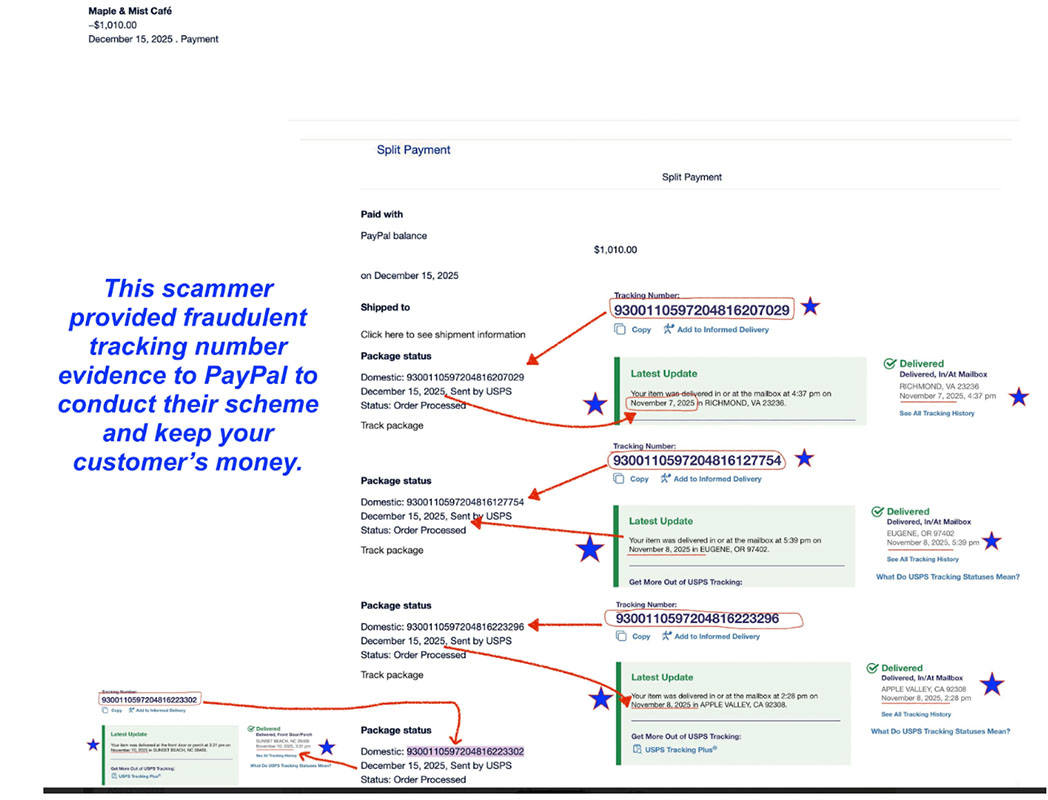
The USPS tracker numbers provided to PayPal by “Maple & Mist Café” to fight Eberhardt’s claim that the $1,010 charge was fraudulent.
And with that evidence accepted by PayPal, Eberhardt’s appeal and secondary appeal, her case was permanently closed in favor of the merchant.
The PayPal customer has no more appeals left of this unauthorized charge.
A defeated Eberhardt wasn’t willing to give up though. That’s when she sent her request for help to the Consumer Rescue team.
Consumer Rescue investigates: What does that evidence really show?
When Eberhardt’s request for help landed on my desk, it was clear she was running out of steam. She had been battling an AI agent and a fake merchant for weeks. Eberhardt had already dedicated a significant amount of time looking for information about Maple & Mist Café. That investigation had turned up exactly nothing. In fact, the company has no digital footprint nor any valid contact information.
But the scammer actually provided all the evidence I needed to prove that this was a fraudulent transaction. That proof was contained in the list of USPS transactions.
It’s easy to track packages sent through USPS, UPS and FedEx. With the tracking numbers anyone can find crucial details like the origin of the package, where it went… and the date of delivery.
Those details were something that this scammer hoped no one at PayPal would check during Eberhardt’s appeal of her appeal.
One by one, I plugged those tracking numbers into the USPS system. They each had been delivered to random and unrelated locations around the United States, none associated with Eberhardt’s address.
But more importantly those tracking numbers were old. Eberhardt’s ordeal began on December 15. The scammer had confirmed to PayPay that the purchase and shipping date was that same day. Yet, each one of those packages showed a confirmed delivery in early November.
The evidence PayPal had used to confirm a valid transaction was actually a smoking gun that proved the opposite.
And even though Eberhardt had hoped that the delay in a decision had meant a human team was reviewing her case, I wasn’t sure. I suspected that the AI Assistant had also been in charge of the higher level appeal. When the “merchant” provided evidence of shipping and delivery, it made the final decision in favor of that bad actor.
It was time for me to reach out to people who I know are human at PayPal to share my findings. But first I created a chart to show proof positive that Eberhardt had had $1,010 stolen from her PayPal account.
I took the evidence from the fake Maple & Mist Café and overlaid my screenshots from the USPS tracking system which showed date of delivery and location. I was confident that with this illustration even the PayPal Assistant would now be forced to agree that Eberhardt was a victim of fraud.
The smoking gun: Overlaying the USPS tracking results side by side with the details provided by the scammers, fraud is undeniable. (Chart: Michelle Couch-Friedman)
Victory for the consumer: PayPal returns Eberhardt’s money to her account
I sent my homemade chart over to our executive contact at PayPal and hoped we could get this troubling situation fixed for her quickly.
📬 Subscribe to:
Tales from Consumer Advocacy Land
Real stories.
Real rescues.
Real advice.
Join thousands of smart travelers and savvy consumers who already subscribe to
Tales from Consumer Advocacy Land — the friendly weekly newsletter from Michelle Couch-Friedman, founder of Consumer Rescue. It's filled with helpful consumer guidance, insider tips, and links to all of our latest articles.
Jill has never purchased anything at a place called Maple & Mist Café and, in fact, I have found no evidence of a company called Maple & Mist Café anywhere. This appears to be purely a scam operation and these scammers are using the PayPal platform for this particular scam.
I’ve included the USPS tracking numbers that this merchant fraudulently provided to PayPal to steal Jill’s money. I’ve added screenshots of the actual delivery information beside each of those tracking numbers to show that those tracking numbers have nothing to do with Jill, the scammer OR a December 15, 2025 shipment. They’re just random tracking numbers.
I’ve investigated other similar cases recently and it appears to me that scammers are now somehow finding USPS and UPS tracking numbers in bulk to use as evidence in their schemes.
Could your team please have a look at Jill’s appeal and reverse this $1,010 charge to her PayPal account? Scammers should not be rewarded for their crafty schemes. Your customer needs the protection of your fraud department in this case. $1,010 is a lot of money to lose and this has caused your customer a great deal of stress during the holidays. She just wants her money returned. Thank you!
Michelle Couch-Friedman, Chief Fiasco Fixer😊
And I’m happy to report that almost as quickly as the PayPal Assistant rejected Eberhardt’s claim, the executive team approved it. Although PayPal declined to comment specifically on her case, our executive told me that PayPal does not tolerate fraudulent behavior and works tirelessly to detect and prevent it. She also recommends that victims of theft can report it to law enforcement and PayPal will always cooperate with those investigations.
Eberhardt’s money was returned to her account and she is super relieved to put this battle behind her.
Michelle, I cannot thank you enough. You were so helpful! I was so stressed and I still cannot believe it [was reversed]. Thank you for all of your help!!!
Jill Eberhardt
You’re very welcome, Jill. I’m happy we could help. This is exactly why Consumer Rescue exists. Happy New Year!
How PayPal customers can fight fraudulent transactions (and avoid them, too)
Unfortunately, scammers are always trolling the internet looking for ways to steal. PayPal is certainly not the only platform that these criminals focus their efforts on. But it is a popular target.
Here’s what you need to know about protecting and defending yourself from fraudulent transactions that could drain your PayPal account.
Install two-factor authentication
Although two-factor authentication likely would not have prevented this particular scam, it is crucial that you enable it on your PayPal account. For that matter, you should install 2-step login on any account where you store a cash balance, bank or credit card information or any other personal details someone could use to steal from you.
By installing two-factor authentication, you’re essentially building a moat around your account to prevent unauthorized entry.
Use a unique email address in your PayPal account
A scammer can’t submit an unauthorized transaction if he or she doesn’t know your PayPal address. Bad actors spend a great deal of time phishing for information that includes your email address. Because PayPal payments are tied to your email address, scammers make requests for payment to random addresses. Sometimes, they get a hit, as in Eberhardt’s case.
To decrease your chances of being targeted by one of these “phisherman” I recommend that you create a dedicated email address for PayPal. This should be unique and only associated with your PayPal account. This will make it quite difficult for scammers to randomly steal thousands of dollars from you.
Warning: a one-penny gift is the gateway to an unauthorized transaction
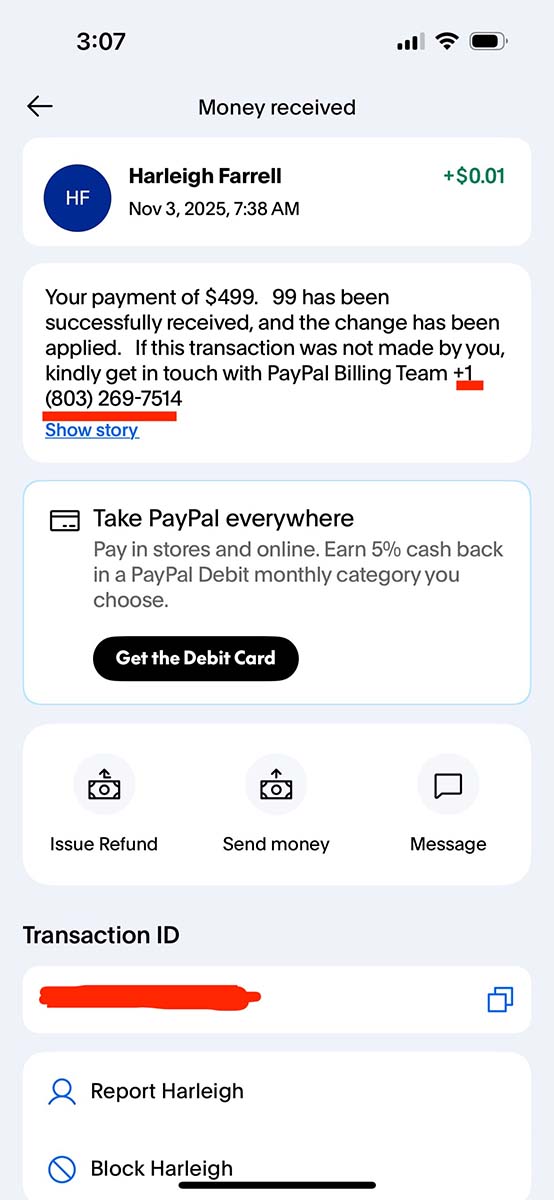
A transfer in your PayPal account for one penny from a stranger is how many unauthorized transactions begin. That penny in your account is a phishing expedition. Never formally accept or respond to any notifications that someone has sent you a penny. This is how scammers confirm they’ve found an active email address tied to a PayPal account.
Instead, you should block and report profiles you don’t know that are trying to send you a penny.
For reference, I don’t use PayPal very often and haven’t signed into my account for months. But a few days ago I signed in to do my research and there she was, “Harleigh Farrell”: a common phisher(wo)man.
She sent me a penny and if I accept it or engage with her, you can be sure the next request will be for the $499 mentioned here. That acceptance also will prove to PayPal that I have a history of responding to her. And that will make future unauthorized transactions from her difficult to prove.
PayPal customers beware: Never accept a penny from a stranger. That is a phishing expedition.
This scam has multiple layers, since that phone number as you probably have guessed will just lead you, not to PayPal, but to scammers pretending to be customer support. If you call that number, you’ll find yourself with all new problems.
Do not add your bank account as permanent funding source
It is undeniably annoying to be required to add your funding source each time you make a purchase with PayPal. However, it is really a bad idea to leave your banking account as a permanent funding source in your PayPal account. Luckily for Eberhardt, Chase recognized and rejected the scammer’s efforts to drain her bank account. But you can’t rely on that protection.
If scammers get access to your PayPal account or send an invoice with fabricated evidence that you made a purchase, you’re going to have a devastating problem. These bad actors are going to be able to debit your bank account and grab your cash while you try to prove who they really are.
If you use a credit card to fund your PayPal account you will have the protection of the Fair Credit Billing Act. Consumers who use debit cards do not enjoy those same safeguards.
If you have a balance you want to transfer to your bank account, you should add and remove it each time.
Unfortunately, PayPal, like many major corporations in 2026 do not have easily reachable human customer service. If you find yourself a victim of a fraudulent, unauthorized PayPal transaction, the company recommends the path to a resolution is through their help center.
But as we have seen today, and my case files show, Artificial Intelligence is taking over many aspects of customer service across consumer land. If you need help finding a real person who we know is helpful to customers at virtually any major company, send your request to Your Research Valet and we’ll share that contact with you. (Note: I do not publish these contacts because they are constantly evolving. I personally procure the updates to ensure we aren’t sharing incorrect or outdated information.)
Ask Consumer Rescue for help
Of course, if all else fails, and you need a professional investigative team, you know where to find us. We are The Fiasco Fixers and we solve problems free of charge. So if you’re in need of a rescue, reach out to our consumer advocacy team and we’ll be happy to help you too. (Michelle Couch-Friedman, Chief Fiasco Fixer and founder of Consumer Rescue)
Michelle Couch-Friedman is the Chief Fiasco Fixer, founder and CEO of Consumer Rescue. She is an award-winning journalist, consumer advocate, travel writer, mediator, and trained psychotherapist (LCSW). Michelle is also the travel ombudsman columnist for The Points Guy, contributing author at Fodor's Travel and writes Tales from Consumer Advocacy Land, Consumer Rescue's newsletter read by thousands of subscribers each week. In 2026, NATJA awarded Michelle and Consumer Rescue the Silver Award in the Best Independent Travel Blog category in its annual competition celebrating excellence in journalism. Previously, she served as the executive director of the nonprofit Elliott Advocacy. During her six years managing all aspects of that organization from its inception until 2022, she resolved thousands of cases for troubled travelers and other consumers, earning hundreds of 5-star reviews on Great Nonprofits from those she helped. Michelle is a public speaker, and her expert guidance has been cited in the Washington Post, MarketWatch, Consumer Reports, Travel & Leisure, the Wall Street Journal, Newsweek, Popular Science, CNN, CNBC, Boston Globe, CBS News, National Geographic, Travel Weekly, Reader's Digest and more. You might even catch Michelle on TV reporting on a situation. :) Professionally, Michelle is a member of the Society of American Travel Writers (SATW), the American Society of Journalists and Authors (ASJA), and the North American Travel Journalists Association (NATJA). Today, she continues to spend as much time as possible fiercely defending consumers and traveling the world. Contact her at Michelle Couch-Friedman or on Linkedin, Twitter or Facebook. You can also check out Consumer Rescue's "What's your Problem?" Facebook group to get quick answers to your consumer questions.