


Published: Updated:
Loyal Celebrity Cruises passenger Cherie Johnson booked a transatlantic cruise from Europe to South America a year in advance. She and her husband were greatly looking forward to celebrating her 75th birthday during the 3-week voyage. But when the day came to set sail on Celebrity Equinox last November, they were, shockingly, denied boarding the ship.
The couple says Celebrity employees at the terminal made a grave mistake blocking them from their $6,717 cruise. That error ultimately cost the Johnsons nearly $16,000, and they want the cruise line to reimburse them.
But hold on a minute.
Celebrity Cruises says it is the Johnsons who made the mistake. These long-term customers showed up at the pier without visas to enter Brazil — a requirement for the cruise. While the couple doesn’t disagree that they lacked visas, they firmly believe the law is on their side. They say they intended to stay on the ship during its port stops in the South American country. Therefore, they didn’t need visas — at least according to the couple.
Now Johnson says she and Celebrity are locked in a stalemate, with neither willing to concede. She hopes Consumer Rescue can prove she’s right and obtain the compensation she’s convinced the cruise line owes them.
So what does the law really say about international cruise passengers and their required travel documentation? Can a traveler simply opt to stay onboard the ship during the cruise and skip those requirements?
Johnson’s case hinges on those details.
Note: I am using a pseudonym for this couple so that I can report their story with its important lessons without adding to the embarrassment they say this incident caused them.

Planning a special 75th-birthday celebration on a Celebrity cruise
Cherie and her husband started planning her special 75th birthday celebration almost two years in advance of the big day.
“We decided to go to Europe and then sail back on Celebrity Equinox,” she told me. “We would end up in Argentina and fly home from there.”
The Celebrity cruise the couple chose would depart from Lisbon and first stop in the Canary Islands. After that, the ship would sail to Brazil, make two port calls there, and then on to Montevideo, Uruguay. The final destination on the voyage would be Buenos Aires, Argentina.

After exploring Argentina, the couple would make their way home.
“This specific cruise was not merely a vacation,” Johnson explained. “It was the culmination of two years of planning to celebrate a joyous occasion.”
Despite all that planning, they had overlooked a critical detail that guaranteed they would not be boarding that cruise ship.
Celebrity Cruises: “You’re denied boarding. You don’t have the required documentation.”
When Cherie and her husband arrived at the pier in Lisbon, they were eager to start enjoying the ship. Having sailed with Celebrity Cruises many times, they happily reminisced about some of their past voyages as they waited to board. They had no inkling of the insurmountable and unthinkable problem that was just on the horizon.
When they handed over their passports, the ambiance of the moment suddenly changed.
“I need to see the proof of your Brazilian visas,” the Celebrity crew member told the startled couple.
At first, the Johnsons didn’t understand the magnitude of the situation.
“We told the Celebrity agent that we didn’t have visas,” Johnson recalled. “I said it wasn’t a problem. We could just stay on the ship instead of going ashore in Brazil.”
The crew member quickly corrected Johnson’s misunderstanding of the optional nature of the Brazilian visas. No one would be permitted to board the ship without one.
As the couple desperately tried to figure out how to avoid the fate unfolding in front of them, a supervisor appeared. That employee handed them denied boarding cards. They would not be celebrating Johnson’s birthday aboard Celebrity Equinox after all.
“Instead of a celebration, we were left stranded at the port in Lisbon,” Johnson explained. “We were humiliated and facing significant financial damages.”
As the ship weighed anchor and sailed off toward Tenerife, the rejected would-be passengers walked away from the pier in confusion.
Passengers are always responsible to research and confirm their own documentation
Over the next few days, the couple scrambled to make their way back to the United States. At the same time, Johnson started to research Brazilian visas.
Soon Johnson was convinced that Celebrity Cruises had done them wrong. As a result, she concluded that the cruise line owed them for all of the expenses they incurred after being denied boarding by mistake.
“With emergency airfare, food, ground transportation, car service, hotels, it was really expensive,” Johnson told me. “Adding the cost of the missed cruise to all of that, it comes to $15,789.”
When I received Johnson’s request for assistance, four months had passed since that terrible day on the dock in Lisbon. She had sent her demand for $15,789 compensation to Celebrity Cruises multiple times. The cruise line had informed her just as many times that it had no intention of reimbursing the couple for any of those expenses.
If you’re a regular reader of my column, then you already know why Celebrity Cruises rejected her request.
Fact: It is the sole responsibility of the cruise ship passenger to know and present all required documentation for every part of their trip’s itinerary. No cruise line provides refunds when a customer is denied boarding due to lack of required documents.
Johnson agreed with the concept. So why was she asking Celebrity Cruises for the jumbo compensation?
📬 Subscribe to:
Tales from Consumer Advocacy Land
Real stories. Real rescues. Real advice.
Join thousands of smart travelers and savvy consumers who already subscribe to Tales from Consumer Advocacy Land — the friendly weekly newsletter from Michelle Couch-Friedman, founder of Consumer Rescue. It's filled with helpful consumer guidance, insider tips, and links to all of our latest articles.

That’s where things got a bit strange, to say the least.
Who wrote this passenger’s complaint letter with its “legal” demands?
I do not know who wrote Johnson’s demand letter to Celebrity Cruises. It was filled with quasi-legal jargon that had no basis in law. It sounded convincing, if you weren’t familiar with the laws and regulations that pertain to international travel.
Here’s an excerpt of the letter:
The cruise line cited a lack of a Brazilian visa.
The Legal Error: Under Brazilian Decree 86715/1981 (Article 10), a transit visa is only required for those who must enter national territory. As we were remaining under the vessel’s jurisdiction in an international zone, no “entry” was triggered.
Celebrity misapplied Brazilian immigration law to our transit status.
From Johnson’s complaint and demand for Celebrity Cruises to pay her $15,789
This legal mumbo jumbo was repeated throughout the letter and claimed that this decree considered cruise passengers as transit tourists. This isn’t what the decree says, but even if it did, the Brazilian government revoked that decree in 2019.
As of April 2025, U.S. citizens need an eVisa to enter Brazil. Cruise passengers are not in a separate floating country or a sovereign nation. Yet this idea was the entire basis of Johnson’s complaint.
Fact: Cruise lines don’t know what you need to travel
Later in the letter, more incorrect information appeared, claiming that every cruise line has a duty to inform passengers of their entry documents. This is also false information.
And then this:
According to Decreto 86715/1981, specifically Article 10, a visto de trânsito (transit visa) is only granted to a foreigner who, to reach their destination country, must enter Brazilian territory.
As cruise passengers remaining under the jurisdiction of the vessel in an international zone, we did not require “entry” to reach our destination; therefore, the legal trigger for a visa requirement under Decreto 86715/1981 was never met.
Transit Without Customs/Immigration Control:
Official travel guidance for Brazil states that no visa is required for a traveler in transit if they stay within the international transit area and do not clear immigration or customs control.
A passenger who does not disembark is not considered to have entered Brazil’s national territory. As we intended to remain in international transit status, we met the legal criteria for boarding without an e-Visa”
Failure of Communication
Furthermore, Celebrity Cruises failed in its duty to provide timely information.
Note: This is all false information
Fact: A cruise ship is not an international transit area. Every passenger on the ship must have all the legal requirements for entry to that country as a tourist. Travelers cannot simply decide to stay on board the ship and skip the required visa, passport, or health requirements.
If I had to guess, I would say an AI agent created the “legal” letters Johnson sent Celebrity Cruises. These programs often make up facts to support a user’s opinion.
But whatever its origins, it was a mess of false information and gobbledygook. That false legal citations and definitive statements not based in truth had convinced her that Celebrity had done them wrong. The truth is, she and her husband were not denied boarding by mistake.
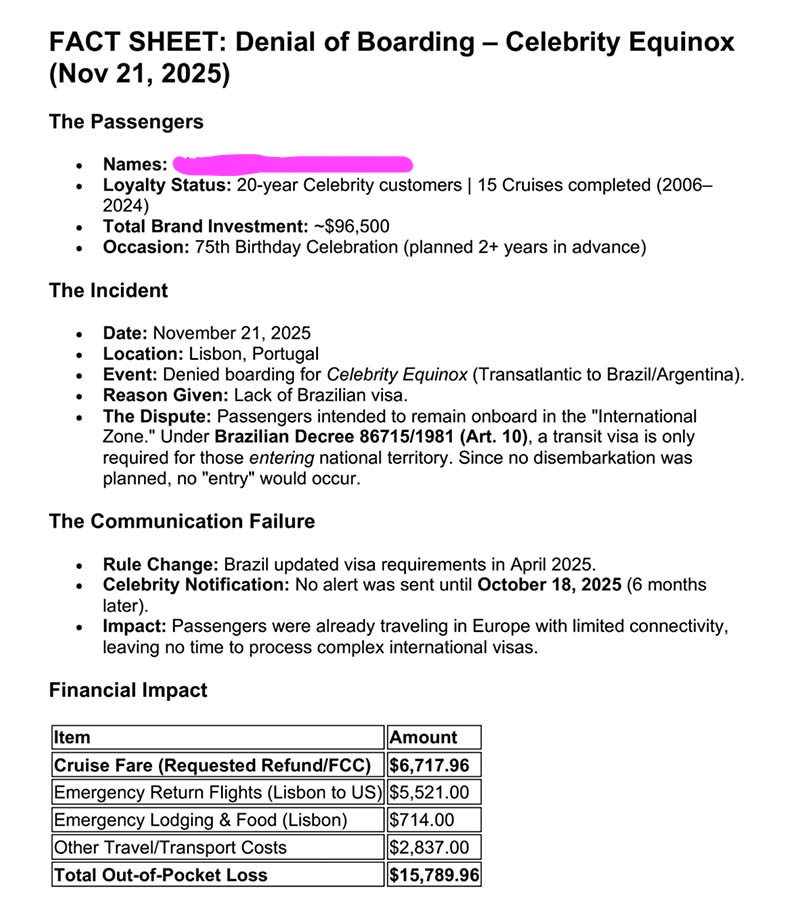
The final incorrect argument on this non-fact sheet claimed that travelers would find an eVisa complicated or difficult to obtain. It is a simple online process that usually results in an approval within a few days. Had the couple read that courtesy email from Celebrity Cruises on Oct. 18, they could have easily obtained their eVisas for Brazil, and Johnson would have had the birthday celebration she had been planning for years.
Related: An Air Canada mistake caused me to be detained in Korea — for two weeks!
Consumer Rescue explains why this isn’t a fiasco we can fix
There is nothing I enjoy more than fixing a fiasco for a consumer. Unfortunately, we can’t resolve every problem that comes through our “Rescue Me” help line. After going through all of Johnson’s paper trail, I gave her the bad news.
Every cruise line includes in its contracts that passengers are always responsible for knowing and possessing all necessary documentation for every part of their cruise.
I am not aware of any cruise line that would allow a passenger to remain onboard the ship when it is headed to a country where the passenger does not have the required documents for entry.
You were denied boarding because you lacked the required documents to enter Brazil and the ship was sailing there. You weren’t “transiting” Brazil as an airline passenger with a connection would. That is what the Brazilian Decree addresses. One of your cruise’s primary destinations was Brazil (a total of three days). If an emergency required the ship or you to be evacuated, you would have been located in a country where you lacked permission to be. The cruise lines face heavy fines for bringing travelers to countries they aren’t approved to enter. Passengers are in Brazil when the ship enters Brazilian waters. The ship is not an independent country.
The cruise line would have only been responsible for this situation if you specifically asked a cruise consultant (a cruise line employee) for documentation advice. If the cruise consultant gave you the wrong advice, you would have a foundation for this complaint. But since you booked the trip with a third party, that isn’t the case here. The fact that Celebrity sent an alert about the visa a month before the trip doesn’t make the company responsible for you not having a visa; that was a courtesy notification. Your contract states that you are responsible for independently checking all your requirements and provides several research links (below).
I’m really sorry I don’t have better news, but unless you’ve left something out here, Celebrity doesn’t owe you anything in this circumstance, I’m afraid.
(Michelle Couch-Friedman, Consumer Advocate)
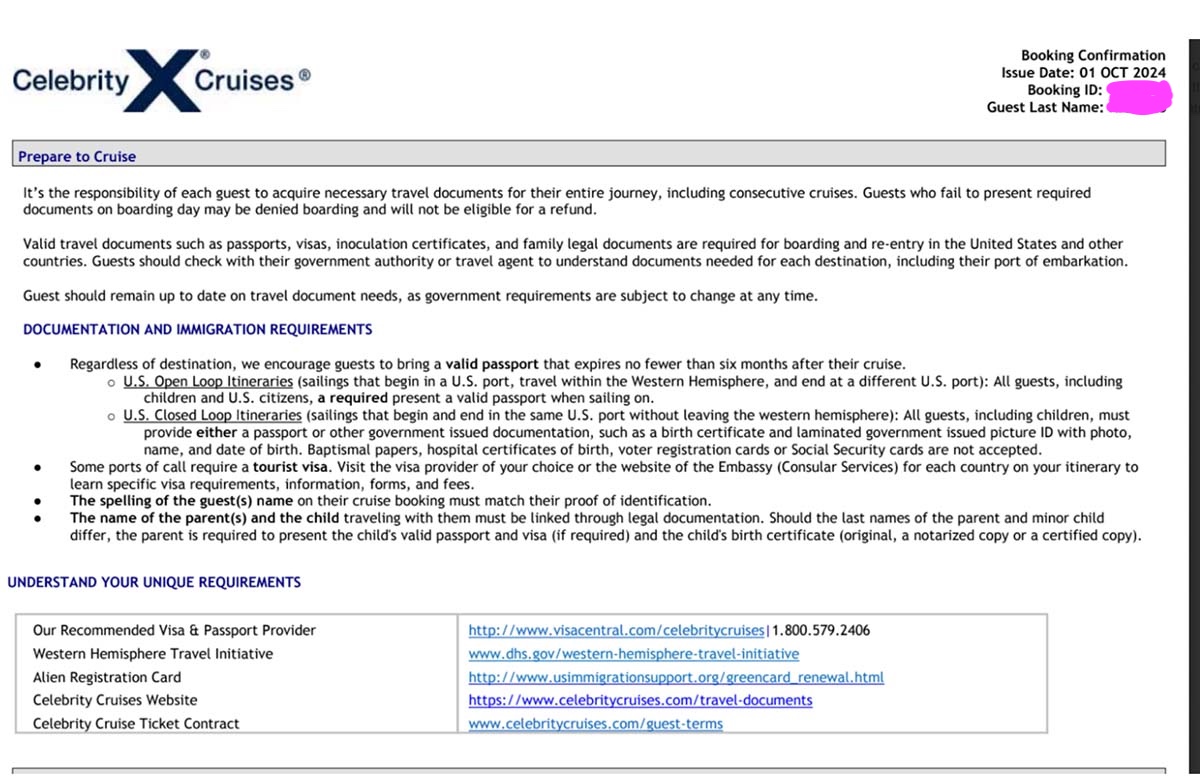
For her part, Johnson has given up this battle. In reality, it seems she just wanted a clear explanation of what happened. Whoever (or whatever) gave her the wrong guidance set her on an even more frustrating path than the one she started on. The laws are clear, the cruise contract is clear, and Celebrity was clear with its loyal customer.
Michelle,
I appreciate you and your team taking the time to review the case I sent over. Thank you for the follow-up and the final determination. We’ve learned a lot from this process, and I can assure you it won’t happen again!
You’re welcome. I’m really sorry that you missed your birthday cruise. I hope you’ll be able to celebrate your 76th birthday with a special cruise later this year!
Related: Cruise passengers beware: No, you don’t have Enhanced ID!
The facts: cruise passengers and international documentation requirements
As Johnson pointed out, being denied boarding at the cruise terminal is a highly stressful, embarrassing and financially-draining experience. However, in nearly all cases that land on my desk, the cruise passenger could have easily avoided the situation altogether. That’s the good news.
Here’s what you should know as an international cruise passenger so you don’t get left behind at the pier.
Cruise passengers are responsible for knowing their required documents
Unfortunately, many cruisers believe that the cruise line is responsible for informing them of what they need to board the ship. This mistaken impression often ends with passengers in tears at the cruise terminal as they are denied boarding the ship.
Passengers should always read their cruise contract which will have plenty of useful information — including recommended official sites where travelers can research and confirm what they must have to board the ship. That contract will also explain what a cruise passenger is owed if they fail to have any of the required entry documents for any part of their itinerary: nothing.
The United States Department of State is a reliable source of information for U.S. citizens to get an overview of the entry requirements for all destinations on their cruise. The website provides passport and visa information among other details for every country in the world. For travelers who aren’t U.S. citizens, visiting the online consulate or embassy of the countries you’ll be visiting on your cruise is the best way to confirm what you’ll need.
Timatac is another helpful tool to get personalized entry and transit information for your trip. Note: Although Timatac is primarily used for requirements that apply if a traveler is arriving by air it can still give cruise passengers important destination entry, health and safety details.
Cruise ships are not floating international transit zones
The core argument that Johnson had was the false idea that Celebrity Equinox was a floating international transit zone. The concept of an international transit zone applies only to passengers who are simply connecting through an international airport, provided they remain airside.
Fact: Cruise ships are not immigration-free safety nets or independent floating countries. Passengers must obtain all required entry documentation for each country on their itinerary.
The United Nations Convention of the Law of the Sea (UNCLOS) identifies the sovereignty of the “territorial sea” as extending 12 nautical miles from land. That means if your cruise ship sails into that zone, you have entered that country’s jurisdiction and all its laws apply. Cruise lines are heavily fined for bringing passengers to places they don’t have permission to be. So if you show up at the cruise terminal without the required documents to enter any country on your itinerary, you will be denied boarding. You can not simply agree to stay on the ship during port stops.
And your loyalty to the cruise line can’t override international law.
Related: These itinerary changes ruined my cruise! Will I get a refund?
International entry requirements frequently change
Booking a cruise a year or more in advance means you can’t assume that entry requirements to every country on your itinerary have stayed the same. You must check again 30 to 60 days before embarkation. That should give you plenty of time to secure any new visa or health requirements. In fact, Celebrity Cruises specifically warns its customers that requirements can change. Don’t ignore that reality.
If you do, you could be in for a terrible surprise when you try to board the ship.
Never disregard communication from your cruise line
If you have begun your trip before the maritime part of your trip begins, it is important that you not ignore any emails from your cruise line during that time. In 2026, it is a rare location that doesn’t have stable and reliable internet. I’ve cruised to some of the most remote locations in the world (the high Arctic and Antarctica) and easily remained in contact with friends, family, and my team. In Greenland, the stellar cell service on land amazed me.
Claiming to have had no internet connection for months to check for updates just isn’t compelling in 2026.
If you receive a message from your cruise line and you’re soon to board one of its ships, pay attention. There is likely some very important information in that message — something that might prevent you from being denied boarding the ship.
Related: We wanted to pay for our Royal Caribbean cruise at the pier. Why couldn’t we?
Do not rely on AI-powered programs for legal guidance
Unfortunately, I’ve recently noticed a trend in the paper trails attached to the requests for help I receive. These include what I am fairly certain are AI-created complaint letters that have been sent to companies. These messages include false facts and AI-hallucinations that, on the surface, sound compelling. But with just a little fact-checking, the foundation of the complaint disintegrates.
Never rely on AI for legal guidance or make it the foundation of your battle with a company. You must do your own research to ensure you have a leg to stand on with your complaint. Johnson’s complaint with Celebrity sounds confident and convincing. Unfortunately, none of it was based in reality.
Consider using a professional travel advisor for complicated itineraries
If you’re planning a very special celebration and it involves cruising to multiple countries, you may want to consider using a professional travel advisor. The American Society of Travel Advisors can provide you with verified agents who have a vested interest in making sure your trip goes as planned.
If you ask your professional travel advisor to ensure you have all your required documents for your cruise, it is highly likely you will.
The bottom line
If you follow all of the above guidance, I can nearly guarantee you’ll have smooth sailing on your international cruise.
But if, despite your careful planning, you are denied boarding at the pier, you can send your request to our team. Consumer Rescue is Your Fiasco Fixer. If there’s a way to solve your problem, we will find it. Our mediation is always fast, friendly, and free of charge. (Michelle Couch-Friedman, Chief Fiasco Fixer and founder of Consumer Rescue)
______