

Published: Updated:
Every week, travelers come to me after losing thousands of dollars on trips that should have been simple. They’re all hoping to find out how to get their money back and who is responsible for their losses. But for some, the answers to those questions are not what they expected.
These are the biggest travel mistakes I’m seeing in 2026 — and how to avoid them.
Assuming geopolitical conflicts lead to refunds and approved travel insurance claims
This year has been a tumultuous one for travelers. A series of unfortunate events has stranded international airline passengers around the world — sometimes for days or even weeks.
In January, the FAA closed the airspace above the Caribbean for 24 hours after what the White House called a “Law Enforcement Operation” in Venezuela. Passengers stuck at airports in the region found themselves with canceled flights and no hotel vouchers or other compensation.
Even worse, the travelers who thought their travel insurance would cover the extra expenses found out later that “acts of war” are an exclusion from coverage. Not surprisingly, travel insurance companies and legal analysts characterized the event as an act of war.
Some of those stranded travelers had splurged on high-priced, limited-availability hotel rooms in the area, expecting their travel insurance to cover the cost. That didn’t happen.
Jack Paster was one of those passengers. He says he’s out over $5,500 that he thought travel insurance would cover.
“We were stuck in Puerto Rico for almost 4 days,” Paster told me. “We assumed Allianz would cover the cost of our delay. But they rejected our claim immediately, pointing to the clause that says we aren’t covered for FAA-closure events.”
More recently, when the war in Iran began, travelers started contacting me asking if they could cancel their travel plans because of the unrest. Some of these travelers had itineraries nowhere near the actual conflict zone. Others had canceled their trips entirely and filed insurance claims that have very little chance of being approved.
A worldwide caution doesn’t qualify for coverage with most travel insurance policies
Maryam Ayad had an upcoming trip to Cairo planned before the Iranian conflict began. Understandably, her family has decided they no longer want to visit the region for the time being. She assumed that ITA Airways would refund their tickets or at least let the group change their itinerary. However, Ayad soon found out that it was an incorrect assumption.
“Egypt Air refunded our tickets, so I expected the same from ITA Airways” Ayad told me. “But they will not budge. The agent told me my tickets are nonrefundable. She wanted me to pay another $8,000 to switch to go to Paris instead. Another agent told me we couldn’t change any part of the ticket.”
Having no intention of paying $8,000 to adjust her flights, Ayad filed a travel insurance claim for the nonrefundable parts of the trip.
Unfortunately, that would not turn in the family’s favor either. Ayad was using Chase’s travel protection which does allow claims based on new warnings of terrorism in a region on your itinerary.
But… Cairo is not on that radar at this time.
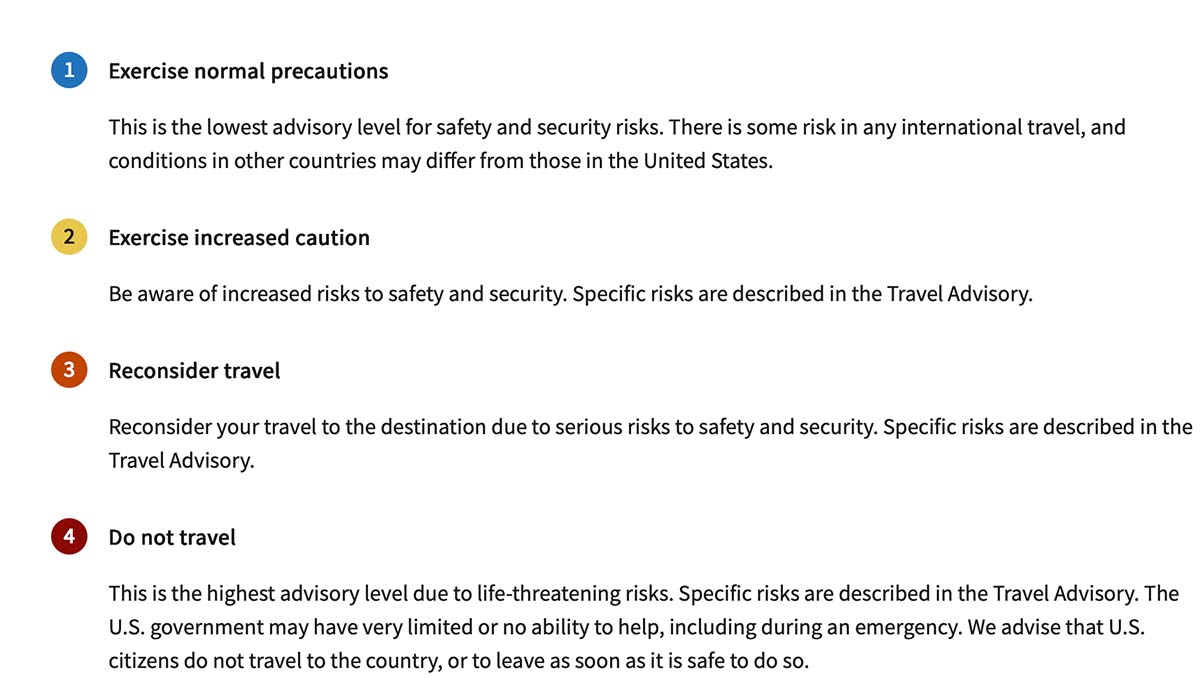
In fact, The Department of State labels Egypt at Level 2 in terms of cautionary warnings. Level 2 means travelers should “Exercise increased caution.” For reference, the same warning level applies to almost all of Europe.
Pro-tip: You can check the warning level for any country you are traveling to on the US. State Department’s website.
Ayad’s policy from Chase Benefits allows her to cancel if:
A Travel Warning due to terrorism issued by the United States Department of State or other branch of the United States Government with jurisdiction to issue such warning for a geographic area within twenty-five (25) miles of an airport, Provider of Lodging, and/or Host at Destination location that is in effect within thirty (30) days immediately preceding the Trip Departure Date.
There is currently no increased Travel Warning due to terrorism in Egypt. So Chase travel benefits would not cover a cancellation to that country.
Travelers should always remember in times of war or unrest:
- Travel insurance only covers certain named perils (specific events). Check what is covered before buying especially if you’re traveling to a region that is prone to unrest.
- Acts of god and acts of war are often exclusions for coverage.
- When in doubt, call your travel insurance company to ask about your policy and its coverage.
- Never cancel nonrefundable parts of your trip on an assumption you’re covered or that goodwill gestures will be provided, always check before canceling.
- Don’t splurge on high-priced hotels or meals under the pretense that your interruption insurance will cover the cost.
- Always read the cancellation terms of your airline tickets before booking and/or canceling to make certain that you aren’t giving up the value of the ticket.
As for Ayad, ITA Airways finally allowed her family to switch their tickets to an itinerary of their choice — for a fee.
“It’s not the best outcome, but we’ll live with it. My family learned a tough lesson,” she told me. “The original price for the ticket was right, but the customer service help wasn’t there. We’ll be sticking to mainstream airlines like United and Delta from now on.”
Related: Is this the worst self-booking mistake ever?
Taking travel advice from AI is a mistake
Here’s a new travel mistake for 2026: Consumers who rely on AI advice for nearly everything. That extends to trip planning and navigating problems during their travels. In fact, some of the travelers who have contacted me recently are surprised to learn that AI overviews and ChatGPT responses can be entirely wrong and even misleading.
In one recent case, an elderly couple was denied boarding their long-awaited transatlantic cruise because of missing visas. After the ship sailed away, they started asking the AI whether Celebrity had made a mistake by not allowing them to board. Their AI program created an entire scenario in which Celebrity was the genesis of their problem. It even created a legal-looking complaint that pleaded their case on the basis of a nonexistent doctrine. The couple sent the letter to the cruise line and requested a refund based on the findings in their complaint.
But it was all Gobbledygook, an AI hallucination. There was no such doctrine.
Not surprisingly, Celebrity turned down their refund request. All passengers must know and possess all the necessary documents needed, including visas, to visit every destination on their itinerary. But when the couple contacted me, they were still under the impression that the information they had been fed was correct. AI had told them that cruise ships are like floating transit zones, so they didn’t need visas as long as they stayed on board the vessel.
That’s nonsense and it cost the couple over $15,000 and they missed a cruise that they had been looking forward to for years.
But they aren’t alone. Everyday I hear from people who have asked AI for advice that has led them to being denied boarding flights and cruises. Some have been given unconventional travel hacks that only led to problems.
AI can be helpful — but it should never be your final source for travel rules, documentation requirements, or legal claims. Always, do your research by visiting fact-checked and official websites like the U.S. State Department.
📬 Subscribe to:
Tales from Consumer Advocacy Land
Real stories. Real rescues. Real advice.
Join thousands of smart travelers and savvy consumers who already subscribe to Tales from Consumer Advocacy Land — the friendly weekly newsletter from Michelle Couch-Friedman, founder of Consumer Rescue. It's filled with helpful consumer guidance, insider tips, and links to all of our latest articles.

If you look carefully, you will see a clear disclaimer after AI responses that “AI makes mistakes.”
Don’t let those mistakes become yours.
Dialing into a fake airline call center is a frequent travel mistake in 2026
I’ve been writing about scam call centers now for years to warn consumers of their existence. But the more I write about them, the more I hear from travelers tricked by Google search results into calling these scammers directly.
Related: Scam call centers are rising on the Internet. Here’s how to dodge them
Some of the recent travelers who have been caught by the scam airline customer service listings have lost thousands after calling the wrong number. Over at The Points Guy, I recently wrote about Mark Marion and his husband, the latest victims of this con. They lost $9,100 after bad actors advertised themselves as Turkish Airlines.
When Marion called, hoping to speak to a TA agent, he was told that his current tickets were only standby. After the fraudster gave Marion a confusing story about refunds and new tickets, he handed over his credit card to the scammer.
Only after hanging up did Marion begin to think he may not have been talking to anyone from Turkish Airlines. When he contacted me, Bank of America had rejected his credit card dispute multiple times because he authorized the charge. In the end, after I went to bat for Marion and explained the scam to our executive contacts at the bank, he finally won his credit card dispute.
Travelers need to keep in mind that credit card disputes don’t typically delve very deeply into the complaint. Scammers are getting more and more savvy. So if you approve a charge to a scammer and then later file a chargeback, you may lose that dispute.
Why credit card disputes can’t often correct this type of travel mistake
Related: Credit card disputes: Everything you need to know before you file one
These bad actors are able to manipulate the merchant information that appears in the credit card terminal and that is what your bank will see. They often use airline names to trick credit card companies as well. The fraudsters are also known to fight disputes — and win.
Reader Ethan Permaul recently found this out when he lost his credit card dispute and appeal over a fraudulent charge. He had called a number he thought was American Airlines. That person somehow convinced him that he needed to pay $4,500 so AA could put him on a Southwest flight. Southwest would refund it all in 30 to 60 days, according to the scammer on the other end of the line.
Of course, it was all baloney.
60 days later when there was no refund, he contacted Consumer Rescue for help. After I provided evidence to Chase of this scam, Permaul finally got his money back.
With all of that in mind, consumers must be vigilant when calling any company, travel-related or not.
Here’s how to dodge these predators.
- Download the app: Most airlines, cruise lines and hotels have their own mobile app in 2026. Put it on your phone so you will also have instant access to the correct number for the travel provider you’re trying to reach.
- Listen: When dialing into a company, always listen to how the person on the other end answers. If they do not clearly state the name of the airline, hotel or cruise line you’re trying to reach, you’ve likely misdialed. Hang up, double check your number and try again.
- Slow down: When you’re making a decision about a change in your reservation. Ask questions if something doesn’t sound right. Scammers often weave tales only meant to confuse you long enough to steal your money.
- Never pay with Zelle or bank transfers: Recently, scammers have been trolling Facebook pretending to be customer service representatives of various airlines. If you post a public complaint about a flight, be prepared to be bombarded in your Direct Messenger by these scouts from the scam call centers. One reader recently lost $5,100 through Zelle and other instant money transfer apps after responding to one of these predators.
Related: Help! Fake United Airlines customer service charged me a $1,750 service fee
Paying fake travel agents for nonexistent trips with Zelle
A list of travel mistakes rising in 2026 would be incomplete without this one: falling for fake travel agents who only accept Zelle.
Customers of a travel agent, allegedly turned fraudster, Tavia Thomas, had paid her over $35,000 via cash, Zelle, and credit cards for non-existent cruises. Many of these stunned would-be cruisers only found out at the pier when they attempted to board the ship that Thomas had never paid for their trips.
And Thomas certainly does not stand alone on the list of fake travel agents trolling for victims. If you’re a regular reader of this site, then you know this is another topic I’ve frequently reported on.
Related: This cruise ship passenger made a big mistake booking this excursion
Remember, one of the favorite payment methods of scammers is Zelle. It’s perfect for their business: instant and irreversible. Zelle and similar apps are meant to be used between friends and family — people you know in person. These transactions have no purchase protection and should not be used to pay for goods and services.
If a stranger, even someone portraying themselves as a travel agent, asks you to pay with Zelle, take that as all the warning you need. Hang up, end the deal and find a reputable (real) travel advisor through word of mouth or on the American Society of Travel Advisors website (ASTA).
Happy and mistake-free travels! (Michelle Couch-Friedman, Chief Fiasco Fixer and founder of Consumer Rescue)