


Published: Updated:
A New Orleans college student ordered a cute pink iPad ahead of the new semester on Amazon. Unfortunately, brazen porch pirates stole the package containing the device just 45 minutes after the driver delivered it.
Now Tarionne Smith is contacting Consumer Rescue for help. She says Amazon initially promised her a $400 refund for the stolen iPad, but now refuses.
So does Amazon refund customers if porch pirates steal their booty?
That’s the question of the day.
The message says Amazon delivered the iPad. So where is it?
Smith says Amazon sent her an alert on August 7 around 5 p.m. that its driver had delivered her iPad. As soon as she received the email, she went straight home.
“Less than an hour after Amazon said the driver delivered my package, I arrived home,” Smith told me. “There was nothing on my front porch. I looked around to see if maybe the driver left my iPad on my neighbor’s door, but it wasn’t anywhere.”
Within minutes, Smith was on her computer reporting the missing package to Amazon. The transcript that she shared with me heavily suggests that she was not speaking to a human. The prompts she received from the “agent” encouraged her to choose from several preprogrammed responses.
After choosing “My package is missing,” the chatbot encouraged her to check with her family and neighbors to see if they had her iPad. Then it told her to wait a few days before contacting Amazon again.
So Smith did as Amazon suggested and waited, but the iPad never materialized.

Reporting the porch pirates to the police — and to Amazon
Four days after receiving Amazon’s delivery alert, the iPad was still MIA. By then, Smith had gone to the local police station and filed a theft report. Then she signed back into her Amazon account and requested a refund for the missing item.
📬 Subscribe to:
Tales from Consumer Advocacy Land
Real stories. Real rescues. Real advice.
Join thousands of smart travelers and savvy consumers who already subscribe to Tales from Consumer Advocacy Land — the friendly weekly newsletter from Michelle Couch-Friedman, founder of Consumer Rescue. It's filled with helpful consumer guidance, insider tips, and links to all of our latest articles.

The Amazon agent immediately said it would process her refund for the full cost of the iPad. Soon after, she received an email confirming the upcoming $439 refund.
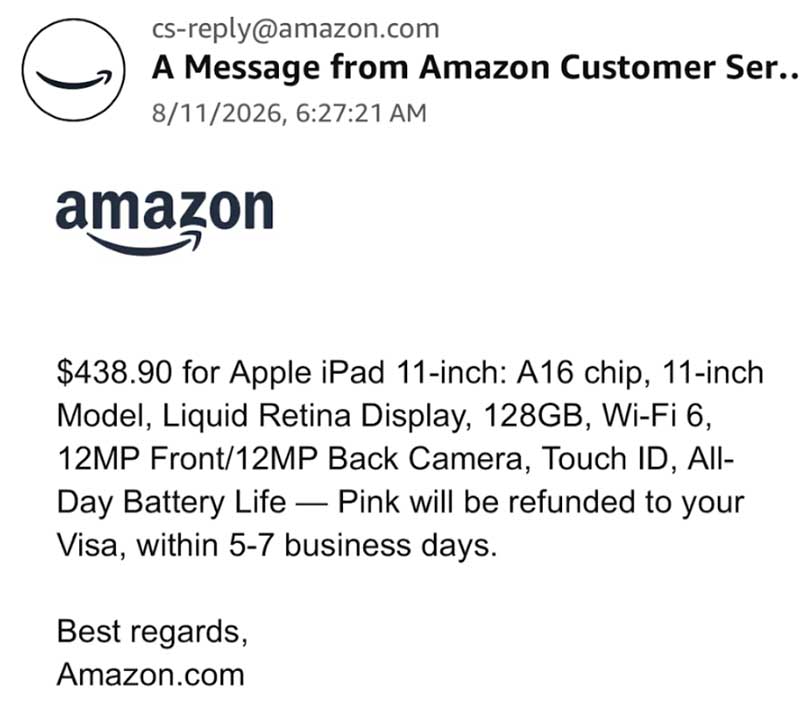
After she closed the chat and received the email, Smith believed the situation was settled. Unfortunately for her, things were just getting started.
Amazon was about to give her a most unpleasant surprise.
Amazon: “We are concerned about the activity on your account.”
At 2 a.m. the next morning, an email notification on her phone woke Smith up. It was titled “Your Amazon Inquiry.” At first, she thought it was just another refund confirmation.
It wasn’t.
In fact, it was a warning from Amazon:
We are concerned about the activity on your account, which is violating the Amazon Returns and Refunds policy. We want to do all we can to help you avoid problems with your Amazon orders.
Your account remains open and available for your use. However, if you violate the Amazon Returns and Refunds policy by requesting refunds for delivered shipments, we may close your account.
Amazon Account Specialist.
Amazon followed up that message a few hours later to clarify the status of her refund.
We looked into your order and the carrier has confirmed the shipment you reported as lost was delivered to you in good condition. As a result, we will not be issuing you a replacement or a refund for the contents of that shipment.
It also went on to reiterate that Amazon’s Customer Service team (chatbots) “cannot reverse this decision.”
However, Smith went right back to the chat window and, for the next several days, repeatedly asked for a refund. Each time, the friendly customer service chatbot confidently told her it had processed her full refund.
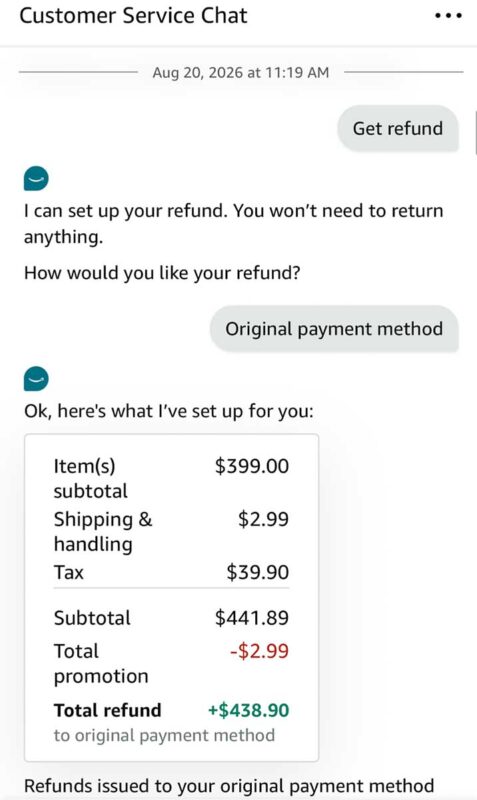
But as AI agents sometimes do, it was telling a fib. The customer service chatbots had no way to override Amazon’s Account Specialists’ decision.
Related: This is how using AI to write complaints can go all wrong (The Points Guy)
Asking Consumer Rescue for help with this porch pirate fiasco
A week after her last attempt to get Amazon to refund the stolen iPad, Smith sent her request for help to Consumer Rescue.
“I ordered an iPad for school from Amazon, but I never received it,” she wrote. “Then Amazon told me that it refunded me, but it never did. Can you help me?”
When I went through the paper trail Smith initially sent, I found it strange that she had not received the refund. The way she worded her request for help made it sound like Amazon never delivered the package. If the iPad never arrived, then a refund or replacement should have been quickly processed.
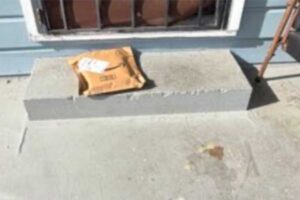
Only after I asked for additional information did Smith clarify that Amazon had photographic proof that its driver had delivered the iPad. The package wasn’t missing in the traditional sense — it was stolen by daytime porch pirates.
Amazon typically does not refund customers for items swiped after delivery.
But I wondered about the harsh response of Amazon’s human team of customer specialists who had warned her that she was violating its policies.
“Have you made a lot of returns lately?” I asked. “Or been having issues with deliveries to your address?”
Bingo.
Related: This is why you should never give an eBay buyer your home address
Repeated Amazon delivery problems
Smith then told me that she had lived in the home with her parents since before Hurricane Katrina. Her family is deeply embedded in their New Orleans community. She didn’t believe porch pirates were roaming about, and she hadn’t had any problems with Amazon previously — until July. That’s when something changed.
“For years, I have enjoyed buying all sorts of things from Amazon — especially home decor and pet supplies,” Smith told me. “I don’t return items. But in July I bought a wig for my birthday to feel special.”
All her Amazon problems began with that pricey wig purchase. First, the delivery was delayed. Then Amazon canceled it. The wig arrived by surprise after Smith’s birthday. She refused delivery since the purchase had already been refunded. But then her next order of cat litter and other minor household items suffered a similar mishap. Amazon refunded her for that order as well.
Then came the iPad fiasco and Amazon’s stern warning.
You might like: Tour guide owes cruise passengers thousands. Why is she on Viator?
Amazon is getting rid of problematic customers
I know from my recent case files that Amazon is culling its customer list. I’ve been receiving a flood of help requests from bewildered, banned Amazon users whom the company identified as frequent returners and/or people who report missing packages at an unusually high rate.
Likely because of the high-dollar value of the recently missing items, Smith quickly went from a darling customer to a problematic one in a matter of weeks.
Clicking the lost package option in some of her chat sessions didn’t help. Her iPad was stolen, not lost.
It was clear to me from Smith’s repeated requests for Amazon’s help that she was desperate to get a refund or a replacement iPad. School was about to begin.
My thought was that if Amazon could at least provide the serial number for the stolen iPad, the police might be able to track it down.
Related: The Retail Equation: How merchants are fighting back against serial returners
Asking Amazon to help track down the stolen iPad
I reached out to Amazon on Smith’s behalf to see if anything could be done for her. I included a copy of the police report. Here’s an excerpt from my message:
Unfortunately, it appears the iPad was stolen from her porch after delivery. I realize Amazon generally doesn’t refund customers for items stolen after delivery, but for some reason, Amazon chatbots repeatedly told her that Amazon would refund this package. However, she then received a warning that her account is now under review, and she didn’t receive the refund.
Tarionne is a young adult attending school and she is just looking for clarity on whether the refund is coming or if the notification was a mistake. I’ll be publishing an article about her experience. I think there is an important consumer lesson here about shipping high-value electronics to an unattended location (even if it is your own front porch)!
I’ve included the police report and some screenshots of her refund request under my signature. Thank you for your help.
Michelle Couch-Friedman (Consumer advocate)
The good news: A real human at Amazon approved a goodwill refund
Soon, Smith got good news. Really good news.
First, my executive contact told me that Amazon intended to resolve the problem for Smith. Then she received verification that Amazon had processed the refund the customer service bot had promised her.
Hi Michelle,
They gave me a $419 refund [the cash amount paid]. I am very grateful for that. I have ordered cameras and cut down on my online shopping.
Thank you for your help! Tarionne Smith
You’re very welcome, Tarionne. I’m glad I could help.
Here is how to protect yourself from porch pirates
In 2026, porch pirates are a menace in many communities. Amazon and other delivery services have responded by setting up safeguards and alternatives.
Mounting outdoor cameras aimed at your front door may deter some porch pirates, but not all.
Here are the best ways to combat pesky porch pirates.
Use Amazon Locker
Amazon Lockers are kiosks located around the country and can often be found on or near college campuses. Customers can have small to medium-sized packages delivered to these lockers.
Amazon Lockers are self-service and can be opened with a touchscreen keypad or through an app on the customer’s phone. Instructions will arrive with the delivery alert.
Before shipping a package to a locker, it’s crucial to make sure that the size of the delivery box will not exceed the locker’s size.
Related: My Amazon gift cards are worthless! What happened?
Use Amazon Counter locations
For Amazon customers who are ordering larger items or who prefer a location with human support, Amazon Counter is the better choice. These stations are located inside participating businesses, including hotels, grocery stores and other locations. Not only can you have Amazon purchases delivered there, but you can also return items from these locations.
You can use Amazon’s Locker and Counter finder to determine the most convenient delivery location for you and add it to your Amazon address book.
Smith will be happy to know that there are numerous Amazon Lockers and Counter locations very close to her home.
Related: Here is how a Craigslist thief quickly stole his Target gift card
Amazon Key — In-Garage Delivery
Another option for customers concerned about porch pirates — or who simply don’t want their packages exposed to the elements — is Amazon Key In-Garage Delivery. This service requires the homeowner to have a smart (Wi-Fi-enabled) garage door opener.
Customers download the app, set up necessary permissions, and authorize delivery drivers to place eligible packages inside their garage. Drivers receive one-time access for each delivery.
The bottom line
Amazon customers should know that Smith’s refund experience is not typical. An AI bot misunderstood her problem and assumed that the iPad had not been delivered. A human reviewer would have asked for clarification about the “missing” delivery. Had Smith been able to explain that the package was stolen, it is unlikely that a refund would have been offered.
In this case, Amazon agreed to honor the refund that its AI offered. But you can’t expect the same outcome. Once a package is delivered to your door, it is your responsibility.
Never send high-valued items to an unmonitored location — especially one that has previously had delivery problems.
Of course, if you believe you’ve done everything right and Amazon has refused your refund, you can send your request for help to the Consumer Rescue team just like Smith did. I will review your paper trail, and if the facts are on your side, we will help you, too. (Michelle Couch-Friedman, Chief Fiasco Fixer and founder of Consumer Rescue)