

Published: Updated:
I’ve spent years writing about Zelle scams and how to recognize and avoid them. That’s what makes what happened to my daughter last week on the streets of Philadelphia so unusual.
There’s a new Zelle scam coming to a city near you, and this one is different from all the others. In this devious scheme, you’ll come face to face with the bold criminal(s). But they’ll be disguised as friendly young adults on a mission to collect small donations to support kids’ sports programs.
Unfortunately, I know this because my youngest daughter fell victim to this scam last week. While waiting for a friend on a busy street in the city of Brotherly Love, a group of teens approached. They told her they were collecting $1 donations to support their local youth sports team.
Their preferred payment method? Zelle.
That detail should have set off alarm bells for my daughter, but it didn’t. She also didn’t immediately recognize the danger when those enthusiastic teens reached for her phone. These bad actors pretended to be facilitating her donation by adding their number to her Zelle contacts.
But minutes later, after they thanked her and walked away, she got the shock of her life. The group had actually sent $2,000 to themselves — in an attempt to drain her bank account.
Here’s the whole story and what you should know about this Zelle scam that exploits the victim’s generosity.

“Will you donate $1 to keep kids off the street and in sports?”
On the day my 22-year-old daughter was scammed, she was distracted by an unrelated unpleasant situation. She is a kind-hearted young lady, a recent college graduate who has lived in Philadelphia for the past four years. But even with that city-life experience, she can sometimes be a bit too trusting. All those details contributed to her vulnerability that afternoon.
Her friend who was meeting her was running late.
As she was texting with her friend, a group of teenagers suddenly surrounded her. The ringleader asked if he could show her their basketball team’s website.
📬 Subscribe to:
Tales from Consumer Advocacy Land
Real stories. Real rescues. Real advice.
Join thousands of smart travelers and savvy consumers who already subscribe to Tales from Consumer Advocacy Land — the friendly weekly newsletter from Michelle Couch-Friedman, founder of Consumer Rescue. It's filled with helpful consumer guidance, insider tips, and links to all of our latest articles.

Not wanting to be impolite, my daughter took a look at the teen’s iPad, which had the website on display. Then he explained that they were collecting $1 donations to get new uniforms. When she told the kid she had no money, he said it was no problem since they weren’t accepting cash.
The scammer asked her to send the $1 to the team’s Zelle account.
“I didn’t see any problem with me sending the $1 through Zelle,” my daughter later told me. “So I got out my phone and asked him for the number.”
By then, the group had been making a lot of friendly small talk with her, explaining how important the team is to them. Ironically, they said her donation would help keep kids like them off the streets and involved in sports.
“They seemed sincere,” she explained. “I told them I was just out of college and I was sorry I couldn’t donate more to their team.”
That’s ok, the ringleader told her, “Every dollar helps.”
Of course, this young con artist had no intention of taking just $1 from my daughter. He was about to attempt to steal 2,000 of her “helpful” dollars.
Related: If your new job asks you to buy some things with Zelle — run! That’s a scam.
The criminals want to “help” their victim make the Zelle donation
As my daughter opened her Zelle app and asked for the team’s number, the head scammer reached out for her phone.
“Give me your phone,” he told her. “I’ll add the number for you.”
She later told me the teen’s request was more of a statement than a question, as his hand touched her phone.
For reference, at just under five feet tall, my daughter is tiny. The teenagers surrounding her, pretending to be on a basketball team, played the part well as they towered over her. And she was alone. By now, she felt intimidated and wanted the group to take their $1 donation and be on their way.
The young man took her phone and typed the number into her Zelle app. He then handed the device back, but now it was powered off.
“He claimed it shut down automatically,” she told me. “I started to turn the phone back on, and they finally left.”
As the teens disappeared into the crowd, my daughter was relieved to be extricated from an increasingly uncomfortable situation. That is, until her phone powered on and a shocking notification popped up on the screen. It was from her bank, and it confirmed she had just made a $2,000 Zelle payment.
Related: What can you do if you sent money to a stranger by mistake?

“Mom, help me! These kids stole all my money.”
I was in my office going through a pile of requests for help when my phone rang. It was my youngest daughter. I could barely make out what she was saying through her hysterical tears.
“Mom, I was just robbed,” she screamed. “These kids asked me for a donation for their sports team. They took my phone and Zelled themselves $2,000. All my money!”
For years, I’ve been warning anyone who will listen — including my children — about the dangers of misusing Zelle, so I found the situation hard to comprehend. One thing became very clear: my daughter hadn’t been listening.
Of course, I didn’t want to make her feel worse than she already did, so I focused on calming my daughter down and mitigating the damage. I asked her to send me a copy of the Zelle confirmation that her bank sent to her.
Suddenly, there was good news for my littlest child.
Related: Surprise! You’re formally invited — to a scam!
The bank found the Zelle transaction suspicious and blocked it
I told my daughter to stop crying, hang up, and first call her bank and then the police to report the crime. Since those boys’ “mission” was most certainly not over for the day, she needed to give their description to the local authorities before they scammed someone else.
Zelle transactions are instantaneous, bank-to-bank transfers. After a sender presses confirm, the money sails off to the recipient’s bank account, never to return. That’s why scammers love to use the app to conduct their thefts. They just need to keep their victim off-kilter long enough to make the instant transfer.
Related: A buy-a-pet Zelle scam cost this victim $4,000. Could it happen to you?
At least that’s how Zelle has historically worked.
Is a new, more consumer-friendly Zelle era here?
A new era of Zelle may be arriving in the form of better consumer protections. I say that because of what actually happened in my daughter’s case.
Since she has never sent or received more than $50 via Zelle, her bank flagged the $2,000 transfer as suspicious and foiled those young budding criminals. Although, in her panic, she hadn’t noticed it, her bank’s confirmation showed that the Zelle payment had not been approved.
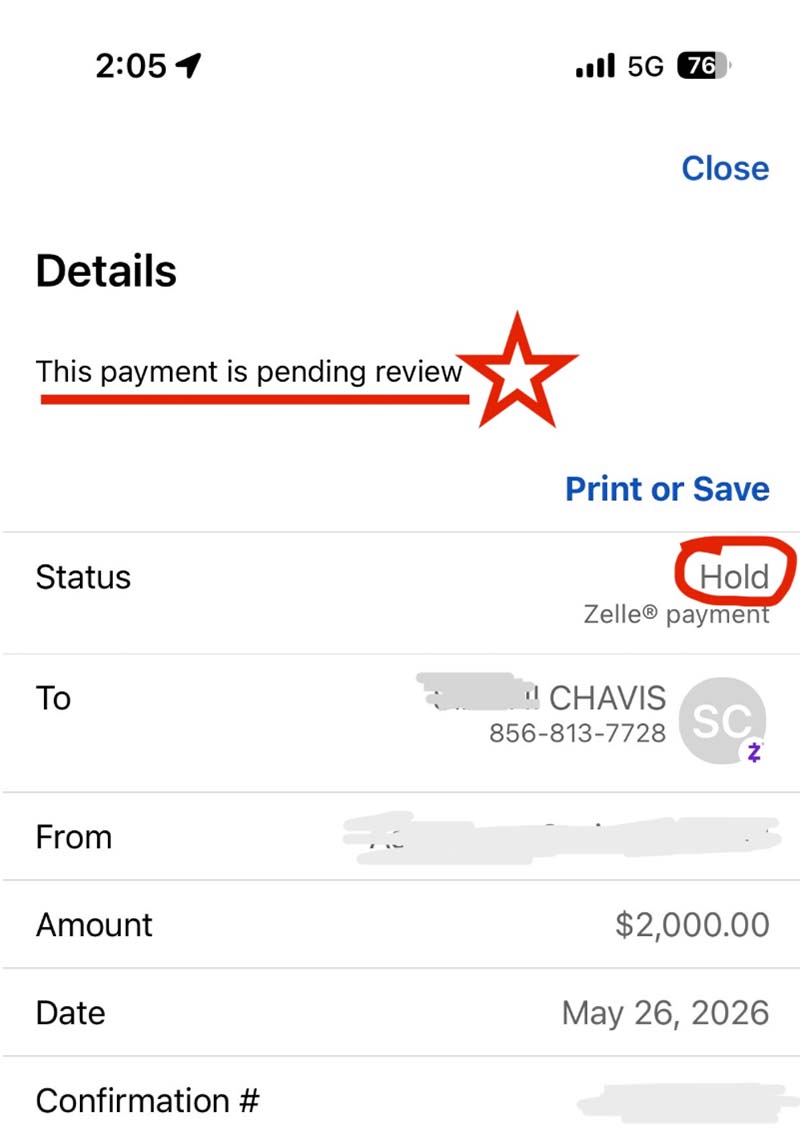
I’m concealing the recipient’s first name because it is quite unusual and belongs to a local athlete. She is no longer a minor, and I believe the scammers are simply using her name
Related: Zelle scams are on the rise. Could you fall for this one?
The bank gives a stern warning about avoiding Zelle scams
After my daughter called the bank, an agent gave her a well-deserved, stern warning about how to properly use Zelle. He emailed her a guide for avoiding Zelle scams and advised her to be more careful.
“I feel like a fool,” she told me. “I must be the only one who would fall for such a scam.”
Unfortunately, she isn’t. I had never heard of this scam before, but after a quick Google search, I learned that it is common in big cities around the country.
One high-profile victim of this scam is a former Miss New York whose experience in Manhattan two years ago mirrors what happened to my daughter in Philadelphia last week. Unfortunately, the former Miss New York wasn’t as lucky as my child. She didn’t get her money back.
But she, like my daughter, wanted to share her story to spread awareness.
Related: What if a stranger sends you money by mistake through Zelle?
Reporting this scam to our Zelle executive contact
I also immediately reached out to our executive contact at Zelle to report this scam. I wondered if the company was aware of this new way bad actors were using Zelle.
It turns out Zelle is aware.
Hey Michelle,
I am so sorry to hear this! That’s exactly the issue, though. It’s these criminals. They can be very convincing, and they go after college students and the elderly. I am glad *** [the bank] blocked the transaction. As difficult as the situation was for her, that’s a success.
Zelle executive spokesperson
I couldn’t agree more. The fact that my daughter’s bank detected the scam before she did is a success for the Zelle system — and a valuable life lesson learned for her (and hopefully others as well).
Related: Here are 7 Zelle scams you should know about in 2026
Consumer beware of on-the-street donation Zelle scams
I think it goes without saying that you should always view people on the street asking for donations — even baby-faced kids — with a healthy dose of skepticism. Here’s how you can dodge bad actors.
Only use Zelle to send money to people you trust
The number one way to avoid Zelle scams is to understand and follow the app’s terms of use. You should only use Zelle to send money to friends, family, and other people you trust. You should not trust strangers on the street — even ones that look like friendly teens on a wholesome mission to promote sports.
Don’t let a professional website fool you
In 2026, artificial intelligence has made it easy for bad actors to create professional-looking websites in minutes. The internet is flooded with fake businesses, non-existent vacation rental listings, scam call centers, and, yes, fraudulent charities.
Never assume a charity is real based on a flashy website.
Avoid making on-the-spot donations on the street
There are many reasons why you should not make on-the-spot donations on the street. Some of those reasons are more dangerous than others. Although this particular scam aimed to drain my daughter’s bank account using Zelle, other in-person cons can be physically aggressive. Roaming predators often ask for donations so that their victims will expose their wallet, which the thief will then grab and steal. If the target resists, the interaction can quickly turn violent.
It’s best to ignore donation requests from strangers on the street. If you believe that the charity might be something you would like to support, wait until you are home and do your research.
In most states, including Pennsylvania, charities must be registered, and you can check their status online.
But I can tell you with 100 percent certainty that no legitimate charity roams the streets asking for Zelle donations.
Never hand your phone to a “friendly” person on the street
Of course, it should go without saying that you should never willingly hand your phone over to a stranger on the street. However, this scam succeeds because the friendly teens convince their targets that they are doing something good. They make small talk and share stories of the kids who will benefit from the sports programs to establish a friendly rapport. When the bad actor reaches for their phone, this is usually the first moment the victim begins to sense that something might be wrong.
In variations of this scam, the criminals not only steal thousands of dollars from their victims but also their phones.
Related: 8 cruise scams passengers need to watch out for now
Report donation scams (and attempts) immediately to the police
Intense embarrassment is a common reaction by victims of this type of scam. That emotion often leads them not to report the crime. That’s a mistake because it allows the roving baby-faced criminals to continue on their “mission” and trick more victims… or worse.
Although most Zelle scams are conducted anonymously so the police can’t investigate them, this one is different. This type of con is much more like a robbery than a simple act of trickery.
Given the tragedy that unfolded just a few days after my daughter was scammed on those same streets of Philadelphia, it is best not to resist if a bad actor tries to aggressively take your phone. In that terrible situation, a 22-year-old college student, just like my daughter, was shot and killed by a thief who wanted his phone.
No phone or any amount of money is worth risking your life. Face-to-face thefts should always be reported to the police. By describing the criminals to the authorities, you could stop others from being victimized.
You might also like: Costco Travel sent us the wrong visa information for our cruise and we got denied boarding!
The bottom line
In my daughter’s case, she learned a valuable lesson about trusting strangers on the street — even ones who appear friendly and only want $1. In the end, she didn’t lose her money, but that’s only because her bank protected her.
It bears repeating: Zelle should only be used to send money to friends and family — people you trust in real life. If you remember that rule, you’ll avoid nearly 100% of the problems associated with the Zelle app. (Michelle Couch-Friedman, Chief Fiasco Fixer and founder of Consumer Rescue)