


Published: Updated:
Kesha Green* made what is arguably the most dire mistake a passenger can make on a cruise ship. Just hours after boarding Carnival Conquest in Miami, she found herself unexpectedly brawling with two young women. Green says the surprise fisticuffs happened after the strangers stole her son’s iPhone and other belongings from a pool chair.
She tracked down the duo and demanded they return her boy’s property, but instead, the confrontation quickly became physical.
Carnival security broke up the fight, took statements, and returned the items to Green’s son. The cruise ship sailed to the Caribbean as scheduled with all the ladies on board, albeit a bit bruised.
*Note: I’m using a pseudonym to protect the identity of the family members not involved in the incident.
Despite the unpleasant start, Green’s family had a great time on the cruise. No crew members on the ship gave her any inkling that there would be severe repercussions for the embarkation-day altercation.
However, after Green returned home, an official letter from Carnival soon followed. It notified her that she was no longer welcome to cruise on any of the line’s ships — ever again. After direct appeals to the cruise line failed, a mortified Green sent a request for help to Consumer Rescue. She hoped we could convince Carnival to pardon her mistake and lift the ban.
So is fist-fighting ever a forgivable mistake on a cruise ship? I’ll answer that question and tell you the outcome of Green’s case in a moment.
But first, let’s look at the range of errors cruise passengers frequently make that lead them to our (free) mediation helpline. I’ll start with the minor blunders that merely present an annoying situation and end with the most extreme mistake — the one that can get you banned from cruising permanently.
Jump straight to the top cruise passenger mistakes

#8 Cruise booking errors (mismatched passenger expectations)
As a travel ombudsman, I often receive complaints from disgruntled cruise passengers after predictable elements disrupted their trips. For instance, the childless couple who wanted a romantic getaway. They made the mistake of booking a cruise during a school break on a line known to be family-friendly. The duo spent their cruise dodging groups of unsupervised kids in the hallways and in the pools and hot tubs.
Their expectations did not align with the reality of cruising during school breaks on a family-friendly line.
Then there was the family, shocked by the extreme weather their cruise ship encountered — during hurricane season.
The good news is that cruise passengers can easily avoid these kinds of fiascos.
How to avoid timing mistakes when booking your cruise
When booking a cruise, it’s crucial to consider more than just the availability in your calendar or a discounted fare. You’ll want to research what the cruise line is known for and other factors that might impact the sailing.
School holidays, spring and summer breaks always lead to an influx of children on board cruise ships. Every state (and country for that matter) has unique school breaks, so keep that in mind during your research.
If what you really want is a child-free cruise, the best thing to do is book on an adults-only line like Viking or Virgin Voyages.
In terms of weather, there are distinct seasons in various areas of the world that pose challenges to cruise ships. During those times, like hurricane season in the Caribbean, cruise lines will frequently discount their voyages to offset the possibility of weather disruptions.
Always research the dates of your cruise for historical weather, school holidays (not just in your local area) and any other events that might alter your experience on your trip.
#7 Inflexible cruise itinerary expectations
Cruise ship itineraries are always flexible and can change at any time. That means cruise passengers need to be flexible too. Unfortunately, many cruisers are entirely unaware of the possibility of itinerary changes — sometimes quite significant — until they experience them.
Norwegian Cruise Line passenger Pawan J. had no idea that the very core of his Caribbean cruise could change. But he found out in the most sudden and unpleasant way last September.
Pawan and his parents arrived at the Manhattan cruise terminal expecting to sail to the Caribbean aboard Norwegian Escape. Unfortunately, at that moment, Hurricanes Humberto and Imelda were barreling straight into the ship’s original path. On the morning of embarkation, NCL and the captain decided that the storm posed a significant safety hazard.
Passengers who packed for 80- and 90-degree weather were shocked to learn they wouldn’t need their summer clothes. Instead of sailing south, Norwegian Escape would go north to Massachusetts, Maine, and then to Canada — no sundresses or bikinis required.
The cruise suddenly morphed from a tropical getaway into a chilly fall foliage sightseeing voyage. The abrupt change hit Pawan and his fellow passengers hard. NCL had given them no advance warning of the significant itinerary changes.
“Norwegian didn’t tell us [about the change] until we got to the terminal,” Pawan told me in an email. “We paid for a Caribbean Cruise, but we mostly got cold ports. Didn’t NCL breach our contract? What does Norwegian owe us?”
Unfortunately, Pawan, just like thousands of other cruisers before him, soon learned the shocking truth.
NCL’s contract (clause 6C) spells out exactly what it owes customers who experience an itinerary change during their cruise: Nothing.
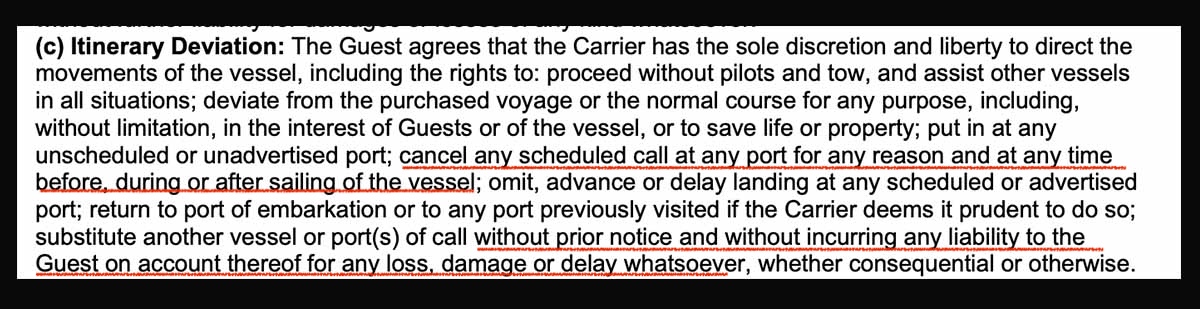
This clause is standard across the cruise line industry.
How to ensure cruise itinerary changes don’t ruin your vacation
It is a mistake for a cruise passenger to assume that they’re buying transportation to a specific destination. When you book a cruise, you’re paying for a cabin on a ship for a set number of days. The itinerary is also subject to change due to safety and operational issues, among other factors. Maritime law says your ship’s captain is in charge of making these decisions.
In the end, 12 ships were rerouted across all major cruise lines as a result of Hurricanes Humberto and Imelda. Pawan says that NCL offered the passengers on his cruise $200 in future cruise credit to make up for their “inconvenience.”
And he and his family learned a lesson about cruising during hurricane season.
Don’t make the mistake of assuming that the cruise you booked will mirror where you will go.
📬 Subscribe to:
Tales from Consumer Advocacy Land
Real stories. Real rescues. Real advice.
Join thousands of smart travelers and savvy consumers who already subscribe to Tales from Consumer Advocacy Land — the friendly weekly newsletter from Michelle Couch-Friedman, founder of Consumer Rescue. It's filled with helpful consumer guidance, insider tips, and links to all of our latest articles.

Related: Our Carnival cruise skipped Greenland. What’s going on?
Understanding that itineraries can change will significantly reduce the likelihood that any alterations to your cruise will disrupt your enjoyment of the trip. Keep in mind that itinerary changes occur most frequently during hurricane season, so although you’ll be getting a better rate, it’s a gamble. If your cruise will be ruined if you don’t visit every port on your itinerary, you should consider booking a land-based vacation rather than a cruise.
Pro tip: Cancel-for-any-reason travel insurance or protection lets you cancel at the last minute if bad weather threatens your cruise ship’s itinerary.
Related: These cruise itinerary changes ruined my trip. Shouldn’t I get a refund?
#6 Cruise passenger buyer’s remorse: expensive “souvenirs”
It’s not uncommon for cruise passengers, influenced by “vacation brain” — and sometimes a few too many cocktails — to end up impulsively purchasing expensive jewelry, art, facial products and even timeshares.
I frequently hear from these cruisers who are suffering from extreme buyer’s remorse after an ill-advised high-ticket purchase aboard the ship. When they arrived home they realized they overspent and, even worse, that they don’t even want whatever it is they bought. They hope I might be able to negotiate the return of the item.
Related: Here’s why you shouldn’t buy expensive jewelry on a cruise
Often these purchases are last-minute, unplanned, unfortunately, almost always come with a receipt stamped “nonrefundable” and “All sales final” receipt.
How to avoid this common cruise passenger mistake
Coming home from a cruise with expensive souvenirs you didn’t plan for and can’t really afford can be devastating. I know this from the hundreds of conversations I’ve had with the various cruisers suffering from extreme buyer’s remorse over the years. Some of these travelers have returned from their trips, with receipts totalling in the four and five figure range. Many can’t explain how they were convinced to suddenly buy such expensive items.
But there are a few ways you can make sure you don’t end up in the same boat.
Related: I was tricked into buying a lab-grown diamond on my cruise!
Always set a souvenir budget before your cruise.If you intend to buy a piece of jewelry or art, make sure to research the item prior to your shopping excursion. Keep in mind that most of the items you see for sale on the ship are overpriced — even when there’s a 60% off clearance tag on it. Don’t fall for it. Stick with your budget so you don’t come home with buyer’s remorse and stuff you don’t even like.
Even though alcohol is abundantly flowing on your cruise, it is a mistake to go shopping while you’re under the influence. And don’t accept cocktails from shop workers. Those drinks are part of the sales tactics and are meant to lower your inhibitions making you more prone to opening your wallet.
#5 Mistaking Real ID for Enhanced ID will get a cruiser denied boarding
In May 2025, Real ID became a requirement for domestic air travel in the United States. When that happened, it caused massive confusion in the cruise world. Many passengers mistakenly believed since Real ID was established as an official identification on domestic flights it must also be acceptable as a standalone identification for cruises.
But that isn’t the case.
A Real ID only proves its holder’s residency. Cruise passengers must provide identification that shows their residency and their citizenship. A Real ID alone will not get a cruise ship passenger the green light to board the ship.
Citizenship is proven by a birth certificate and continues to be a required co-document for cruisers without a passport, passport card or Enhanced ID to board.
Many cruisers like Diana Dipalma and her new husband, confidently show up at cruise terminals each week, with only a Real ID as identification. Dipalma, who hails from Pennsylvania was certain that their upgraded driver’s licenses were Enhanced ID. An Enhanced ID functions much like a passport card and proves its holder’s residency and citizenship.
Enhanced ID driver’s licenses are sufficient standalone identification for passengers to board a closed-loop cruise. But the vast majority of travelers do not have an Enhanced ID, as these are only issued in five U.S. states as of 2026.
Newsflash: TSA introduces a $45 fee for air travelers who don’t have a Real ID
When Dipalma and her husband presented their Driver’s Licenses at the cruise port in Baltimore, they learned the truth. Pennsylvania doesn’t issue Enhanced IDs and the honeymooners also needed birth certificates to get the greenlight to board Carnival Legend.
The couple was five hours from home and had no way to get their birth certificates before the ship closed boarding. They missed their honeymoon cruise and the money spent on it.
How to make sure you don’t mistake a Real ID for an Enhanced ID
An Enhanced ID Driver’s license looks quite similar to a Real ID driver’s license, but if you mistake one for the other, you will be denied boarding your cruise. Here’s how to tell the difference:
As of 2026, only these five U.S. states issue Enhanced ID cards, so if you don’t live in one of the states, you can be sure you do not have one.
- Michigan
- Vermont
- Washington
- New York
- Minnesota
Even if you live in one of the issuing states, that doesn’t guarantee you have an Enhanced ID. You must apply for an Enhanced ID; otherwise, your state will issue you a Real ID or standard driver’s license.
An Enhanced ID says those words at the top and there will be a U.S. flag somewhere on the front of the card. A Real ID has a gold star on its face.
Remember you can fly domestically with a Real ID. But to board your cruise you always need to prove residency and citizenship. So if you don’t have a passport, passport card or Enhanced ID, you will also need a birth certificate to board your cruise.
Related: Cruise ship passengers beware: You do not have an Enhanced ID!
#4 Skipping travel insurance
You probably wouldn’t dream of allowing your health insurance to lapse for a week or two. After all, should you become sick or injured during that time you would be responsible for all your medical bills. And we all know the high cost of medical treatment in the United States. Just one uninsured trip to the hospital can put a person in debt for years.
And here’s a newsflash: Emergency medical treatment on a cruise ship is even more expensive.
Yet, each week untold numbers of cruisers make the precarious mistake of boarding ships bound for international waters without travel insurance — a place where domestic health insurance typically ceases to be valid. Many of those passengers aren’t even aware of the fact that they’re traveling uninsured. That is, until a calamity puts them in sick bay or, even worse, they need to be evacuated from the ship.
Maureen and John Niland were looking forward to a relaxing Caribbean cruise when they boarded Holland America’s Eurodam. Unfortunately, they had only just set sail when John collapsed and died of a heart attack on the ship.
Over the coming weeks, Medicare determined that John’s death occurred internationally (defined as at least six hours from the United States border). As a result,Medicare would not cover John’s astronomical medical expenses onboard the ship. Without travel insurance, that left Maureen responsible for all of the bills, including the repatriation of her husband.
It was a one two punch to the new widow who hadn’t even considered that she and John were cruising without medical insurance.
How to avoid this expensive mistake: Protect yourself with travel insurance
In the end, there was a little good news for Maureen. It was later determined that Eurodam had been a little less than six hours from the U.S. shore. A supplemental domestic insurance policy the couple held covered John’s medical bill and return to the states.
This potentially catastrophically expensive mistake is a simple one to avoid. Any time you venture out of the country whether on a closed-loop cruise, by car or by air, protect you and your family with a comprehensive travel insurance policy.
Some cruise lines and destinations require passengers to purchase travel insurance which includes evacuation coverage. These are typically expedition cruises to remote areas like Antarctica or the Arctic Circle.
Related: Amazing things you’ll see and do on your Arctic cruise
But for the most part, cruise lines leave it up to their passengers to decide on travel insurance. Unless you can afford to self-fund a medical emergency or a complete loss of your cruise fare should you need to cancel, you need travel insurance.
Using a site like Squaremouth or InsureMyTrip you can compare and contrast a variety of travel insurance policies based on your personal details.
Always keep in mind that you have 10 to 14 days after purchasing a travel insurance policy to change your mind. After that, it becomes nonrefundable. So use those days (the “lookover period”) to make certain that you’ve purchased a policy that provides the coverage you need.
#3 Yikes! Astronomical roaming charges on your cruise
Barely a week goes by that I don’t hear from a traveler, often a cruise ship passenger, who made the mistake of failing to research their cell phone plan before an international journey. That oversight frequently leads the cruiser to come home to thousands of dollars in surprise roaming charges.
In fact, just last week I received a plea for help from a woman whose parents returned from a two week adventure to the Falkland Islands. The trip generated endless once-in-a-lifetime memories — and a $2,700 surprise roaming charge. The shocked couple had assumed their T-Mobile international daily pass covered them for all parts of their expedition.
It didn’t.
As they explored the Falkland Islands, they were completely unaware that each day they were accruing hundreds of dollars in roaming charges.
And they aren’t alone. Regular readers of Consumer Rescue likely recall Carnival Cruise Line passengers Cesar Resendiz and his wife. They thought a cruise would be a great way to celebrate their wedding anniversary. It was, until they received their cell phone bill the next month from Spectrum. They couple had accrued a whopping $2,400 in roaming charges as they cruised through the Caribbean on Carnival Venezia.
But, by far, the worst roaming mistake I’ve seen Luke Elie made. He and his cell phone arrived in the Maldives late one evening, and he began to freely use the device — for two days, without checking his coverage. By the time he realized his mistake, he had managed to amass a nearly $7,000 roaming bill.
How to avoid making an expensive roaming mistake during your cruise
Spoiler alert: after contacting Consumer Rescue, Spectrum granted one-time goodwill gestures to both Resendiz and Elie. However, travelers can’t expect this type of treatment. It is not routine. Most cruise passengers who mistakenly allow their mobile devices to connect to international towers without coverage end up stuck with the bill.
The easiest way to make sure you don’t get blindsided with unexpected roaming charges after a cruise is by putting your cell phone in airplane mode. What many travelers are unaware of is that mobile devices will attempt to connect to cell towers if not in airplane mode. That is true even if you’re not actively using the phone.
The first thing you should do when you board your cruise is to turn off roaming capabilities on your cell phone. If you’re traveling with your children, don’t forget to put their devices in airplane mode. Make sure they understand that they can’t change the setting while on the ship. Unfortunately, I have fielded pleas for help from parents whose children ran up thousands of dollars in roaming charges playing video games or watching TikToks on their phones.
Before using your phone on land, internationally, check with your cell service provider to confirm coverage.
#2 and #1: Drinking excessively/ disruptive behavior
The final two cruise passenger mistakes are almost always intertwined: drinking excessively and disruptive behavior.
This brings us back to Green and her fight aboard Carnival Conquest.
In the final incident report, there was no clarity about what actually happened that day. The statement from Green’s “opponents” included accusations that someone stole their belongings from a pool chair. When she arrived on the scene, it escalated from a he-said-she-said into a physical fight, and security broke it up.
Given the murkiness of the situation, Carnival allowed all three ladies to complete the cruise. But that only happened after they all agreed to:
- Steer clear of each other
- Refrain from all alcoholic beverages
Green says no one mentioned that Carnival would also permanently ban her from cruising on its line. However, I know from my case files that her placement on the Do Not Sail list was all but guaranteed after the brawl.
Carnival Cruise Line, has a zero tolerance policy for disruptive passenger behavior. That rule applies to every passenger — even children.
Related: Carnival banned my 9-year-old son. Can you help?
Becoming involved in a physical altercation with another passenger aboard a cruise ship is not a forgivable “mistake.”
I have fielded many pleas for help from cruise passengers who have been banned for fighting. Some of them have been banned years ago and still the cruise lines remain firm. But what nearly all of the incidents I have reviewed have in common is that alcohol featured prominently in the narrative of what happened.
In Green’s case, she told me that the other two women were drunk. However, the fact that security required Green to agree not to drink any alcohol for the remainder of the cruise suggests that she was also suspected of being under the influence.
And of course, getting heavily intoxicated isn’t hard to do on a cruise ship where alcohol freely flows. Unfortunately, it is at the root of most disruptive behavior you hear about on cruises.
What to do when faced with a security problem on a ship
When Green contacted me, she wanted me to plead her case with the cruise line. But I already knew what the answer would be from the Carnival executive team. In fact, by the time she emailed me, Carnival had already sent Green’s case to its legal department. That detail made my involvement impossible. We don’t have attorneys here at Consumer Rescue who can interface with a cruise line’s legal team or investigate onboard altercations.
As a consumer advocate, I mediate cases based on established regulations, terms of use, and contract details. My reputation relies on my team and I only bringing cases to companies in which a company has wronged a customer. Cruise lines are free to ban any passenger who they have determined to be problematic.
Green maintains that her banishment isn’t fair because she wasn’t the aggressor. While that may be true, she did fully participate in the fight once it began. And the truth is, hers is only one side of the story. I had no basis to ask Carnival to lift the ban on Green.
Cruise passengers should not confront other guests. Every ship has security teams whose job is to address onboard issues. Suspected theft and other security issues should always be handled through the proper channels. Attempting onboard vigilantism will almost always end poorly — like getting into a fistfight with strangers, and being handed a lifetime ban from your favorite cruise line. And that is a fate that is entirely avoidable. (Michelle Couch-Friedman, Chief Fiasco Fixer and founder of Consumer Rescue)
Before you go: Cruise ship passengers find out at the pier that their travel agent failed to book their trip
If you have a problem you can’t solve on your own, send your request to our consumer advocacy team. We will investigate and help you if the facts are on your side. Use the button below to reach us. A member of our team will respond to you within 24 hours.