


Published: Updated:
A common travel insurance mistake caused a reader’s entire $19,000 claim to be rejected. Here’s what Consumer Rescue did to help and what you need to know to avoid making the same costly error.
______
Last winter, Steven and Jean Eichberg got the cold-weather blues. To combat that condition, the couple began planning a springtime vacation to central Italy. They would spend six weeks enjoying all that Tuscany has to offer. To make sure they were fully immersed in the locale, they booked a beautiful villa for the bulk of the trip.
A nonrefundable $8,000 villa.
After making all the arrangements, including business-class flights, they wisely purchased travel insurance to cover nonrefundable parts of the trip.
With their Italian getaway planned and protected, there was only one thing left to do: count down the days until departure.

Off to Italy with a comprehensive travel insurance policy in place
In April, the Eichbergs headed to Boston’s Logan Airport and soon were on their way to Italy.
About three weeks into their trip, they arrived in Lucca. Nicknamed the “City of 100 Churches,” this medieval town is known for the perfectly preserved ramparts that surround it.
In Lucca, Jean became unwell. Her symptoms quickly escalated and it became clear that she needed to see a doctor.
“She was in a lot of pain,” Steven recalled. “We were in a hotel at that time, and they called us a taxi. We went to the local hospital.”
📬 Subscribe to:
Tales from Consumer Advocacy Land
Real stories. Real rescues. Real advice.
Join thousands of smart travelers and savvy consumers who already subscribe to Tales from Consumer Advocacy Land — the friendly weekly newsletter from Michelle Couch-Friedman, founder of Consumer Rescue. It's filled with helpful consumer guidance, insider tips, and links to all of our latest articles.

Steven says they were very grateful for their taxi driver. Understanding that the couple didn’t speak Italian, he went into the hospital with them. He made sure the medical staff understood that Jean’s condition was an emergency and that she was in great pain.
“We bypassed the regular waiting area because of the taxi driver’s help,” Steven recalled. “But there were a lot of communication problems after he left.”
Trying to get clarity for travel insurance purposes
For the next 20 hours, Jean was subjected to an array of tests and received intravenous medication. Eventually, her pain subsided and, exhausted by all of the prodding, she asked to be released from the hospital.
The attending physician gave her a suspected diagnosis and recommended that she drink plenty of fluids. The discharge document, which was entirely in Italian, also advised her to return to the hospital if the symptoms reappeared after the pain medication wore off.
*I’m redacting the diagnosis to protect Jean’s privacy
The couple’s much-anticipated Italian getaway had taken a terrible turn. The next part of the trip would take them further from the hospital. Neither Steven nor Jean felt it was wise to continue.
“Since we had travel insurance to cover the nonrefundable parts of the trip, we decided to go home,” Steven told me. “I called iTravelInsured to inform them that Jean was unwell and we needed to leave.”
Steven says he doesn’t recall the entire conversation since they had been up all night at the hospital. But he’s sure the agent didn’t advise them not to go home. So the couple quickly packed their suitcases and went to the airport. They bought last-minute, one-way business-class tickets back to Boston and soon boarded the plane.
Unfortunately, they left Italy without documentation from the hospital recommending this extreme course of action. That mistake would prove to be insurmountable when they filed their travel insurance claim.
Related: We missed our Princess cruise. Did we really just lose our $21,000?
Can a travel insurance company approve and then deny a claim?
When I heard from the Eichbergs, it was nearly three months after their ill-fated trip to Italy. Jean was fully recovered, but now the couple was battling their travel insurance company.
Just a few days after filing their $19,000 travel insurance claim, they had been relieved to receive an approval notification. That should have been a bit of a red flag, since claims typically take several weeks to review and process — especially high-value claims like theirs.
After receiving the approval notification, the couple waited a week before asking IMG (International Medical Group), the parent of iTravelInsured, about the missing funds.
Steven explains what happened next:
That’s when the travel insurance company told us that the initial approval was a mistake. Then, they said our claim was actually rejected. Completely. How can that be? They said the policy only covers trip interruption if a doctor specifically says the patient is unfit to travel. I did ask the physician in Lucca if she recommended I take Jean back to the United States. I understood her to say “yes” and I thought she wrote it in the discharge documents.
I think something was lost in the translation.
Indeed, something was lost in translation.
Related: Here’s an $11,504 travel insurance mistake you won’t want to make
Google Translate reveals the doctor’s recommendations
My Italian is pretty rusty, so I used Google Translate to read through the doctor’s discharge papers. Unfortunately, I discovered the same thing IMG had found: The doctor made no recommendation for Jean to go home or that she was unfit to travel.
However, I thought the doctor’s description of Jean’s condition implied that she shouldn’t be on vacation. After all, she was heavily medicated to manage the pain, and her problem was at risk of worsening, according to the doctor’s own words.
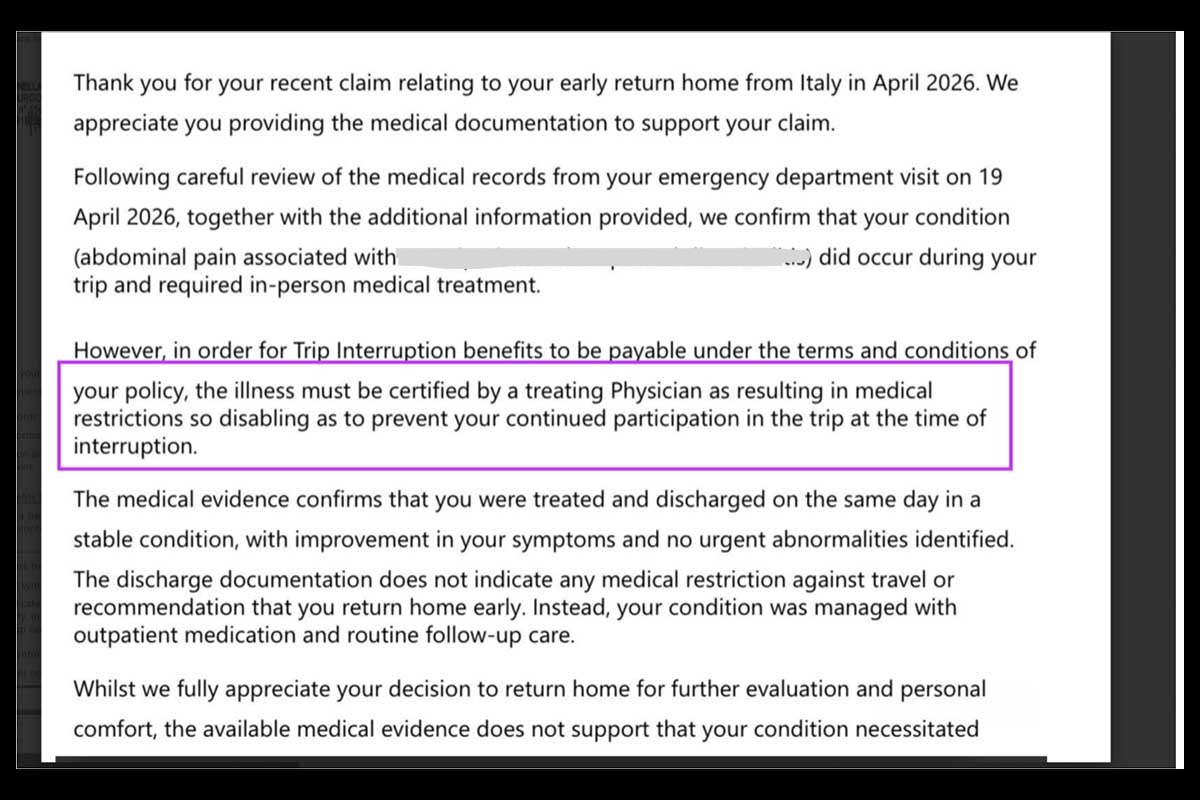
But travel insurance adjusters do not often consider implied messages — and the iTravelInsured claims adjuster didn’t. As a result, the $19,000 Trip Interruption claim was rejected. The initial approval of the Eichbergs’ claim appears to have been a computer glitch — issued before the case had been reviewed.
In his denial summary, the adjuster quoted directly from the terms and conditions of their travel insurance policy, “…The illness must be certified by a treating Physician as resulting in medical restrictions so disabling as to prevent your continued participation in the trip at the time of interruption.”
But I still believed there was a way to reverse the denial through an appeal. All we needed was an additional statement from the doctor who treated Jean.
Related: How buying travel “protection” from your tour operator could be a $20K mistake
Delivering the crucial document to IMG to reverse this travel insurance mistake
With $19,000 on the line, I advised Steven to contact the hospital again and press harder for additional clarity about the doctor’s recommendation for Jean. Steven then contacted the hospital’s ombudsman, explaining their predicament.
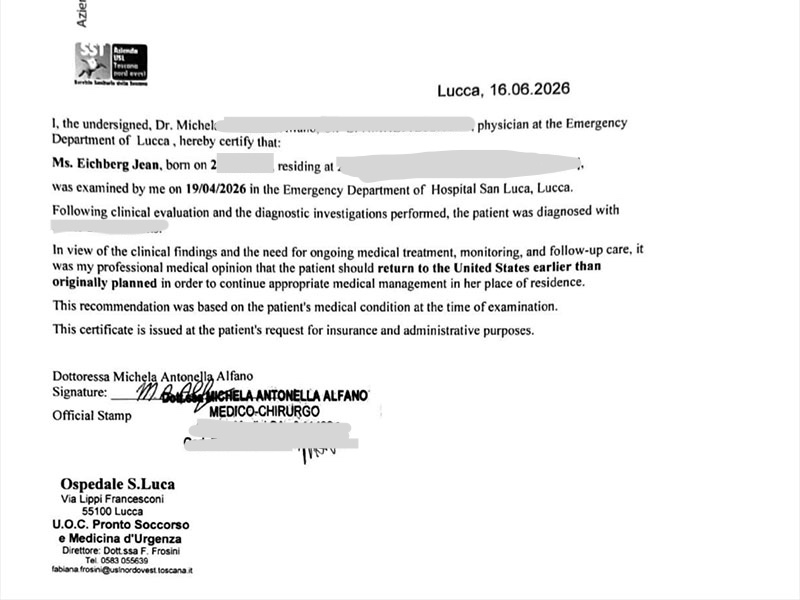
The hospital and doctor were more than happy to provide an official letter with the doctor’s formal opinion that Jean was not suitable for traveling. Steven forwarded the document to me. Since that missing information was the foundation of the rejection, I felt confident that IMG could now reverse its denial.
I sent the document to our executive contact at IMG and asked for it to be added to the appeal.
Today I am working on a case involving an IMG customer, Steven Eichberg (Claim #*****). He and his wife traveled to Italy in April and insured the trip with an ITravelInsured policy (*****). Unfortunately, his wife (Jean) suffered [Redacted for privacy] and was rushed to the hospital during the trip. She remained in severe pain after discharge and the doctor recommended bed rest. The couple called iTravelInsured for guidance. The call occurred on April 19, at 4:13 am (a 20 minute call from Italy). Steven says the iTravelInsured agent told him to make arrangements and fly home and file a Trip Interruption claim.
iTravelIinsured first approved the entire claim and then, a few days later, stated that the approval was a mistake.
After translating all the Italian medical documents, an agent determined that the doctor never specifically stated Jean was unsuitable for further travel. A few weeks later, another agent stated that only a third of the claim could be approved. All of this hinges on the crucial missing recommendation by the doctor, which Steven and his wife both understood to be that Jean should not continue her travels in her condition.
When Steven reached out to me for help, I recommended he try to get clarification from the hospital since Jean’s condition certainly didn’t sound like she was suitable for ongoing travel.
This morning we received a clear explanation and recommendation from the attending physician who treated Jean in Italy on April 19. Her recommendation was indeed to interrupt their travel and let Jean go home to recover. I am including that document below my signature along with some of the other evidence.
Based on this letter from the treating physician, it seems the couple’s policy should cover all their nonrefundable expenses incurred as a result of Jean’s sudden and painful medical condition.
I will be writing an article about the couple’s experience as a cautionary warning to travelers about the requirement to make sure that they’ve received a medical recommendation to interrupt a trip before you actually do so. This appears to be a common traveler error based on my case files.
Thank you for your help!😊 Michelle Couch-Friedman, Travel Ombudsman
Related: Hurt on vacation? Don’t make this travel insurance mistake
Good news: This $19K travel insurance mistake is reversed
Travel insurance claims in the United States are generally reviewed and adjudicated within 30 days. Appeals often follow the same timeline. I provided the necessary documentation to have the Eichbergs’ claim approved, and our executive contact confirmed that the appeal was initiated.
Just under the 30 day mark, Steven received the good news.
Michelle,
Thank you so much for your help and guidance in this ongoing saga, which began on April 19th with the interruption from our trip. I did send a big thank you to the Lucca, Italy hospital for sending the letter that sewed this all up. As I had told you, I tried to get the doctor to note that on the original notes when leaving the hospital, but because of all that was going on, I did not see it.
Fortunately, the hospital had a type of ombudsman department, and they were wonderful in their communications, as were you and your team. Since this is the first time I had to reach out to someone like yourself, I have definitely learned a few things and thank you for your assistance. We never travel without insurance (has covered us on a few cancelled trips) and will continue to buy it whenever we travel, domestically or internationally as you never know!
Kind regards,
Steven Eichberg
In the end the Eichberg’s received just over $19,000 … and an important travel insurance lesson. That figure represents their last minute airfare, missed villa and some other incidentals.
For its part IMG offered me a statement for our readers:
Hi Michelle,
Travel insurance is designed to provide important financial protection when unexpected events occur, but coverage is always subject to the specific terms and conditions outlined in the policy. We encourage customers to carefully review their plan documents prior to purchase and travel, including understanding what documentation may be required for certain types of claims, such as trip interruption. Providing complete and timely documentation can help facilitate a smoother claims evaluation process. IMG administers claims in accordance with policy terms and works with customers to review any additional information submitted in support of their claim.
Spokesperson for IMG to Michelle Couch-Friedman at Consumer Rescue
The bottom line
If you get sick while traveling, be sure to get a doctor’s written statement saying you should return home — before you pack your bags and leave. Unfortunately, for travel insurance purposes, you do not get to decide if you’re too sick to travel. That’s up to the medical professionals, and that is the only opinion travel insurance companies will rely on.
If you need help interpreting your travel insurance policy or an appeal, Consumer Rescue is here for you. Join our What’s Your Problem Facebook community for quick questions. For direct mediation assistance, send your request directly to the Consumer Rescue advocacy team.
Our assistance is always fast, friendly, and, best of all, free. (Michelle Couch-Friedman, Chief Fiasco Fixer and founder of Consumer Rescue)
Before you go: His rental car crashed into the sea. Now he’s in a $27K insurance nightmare